

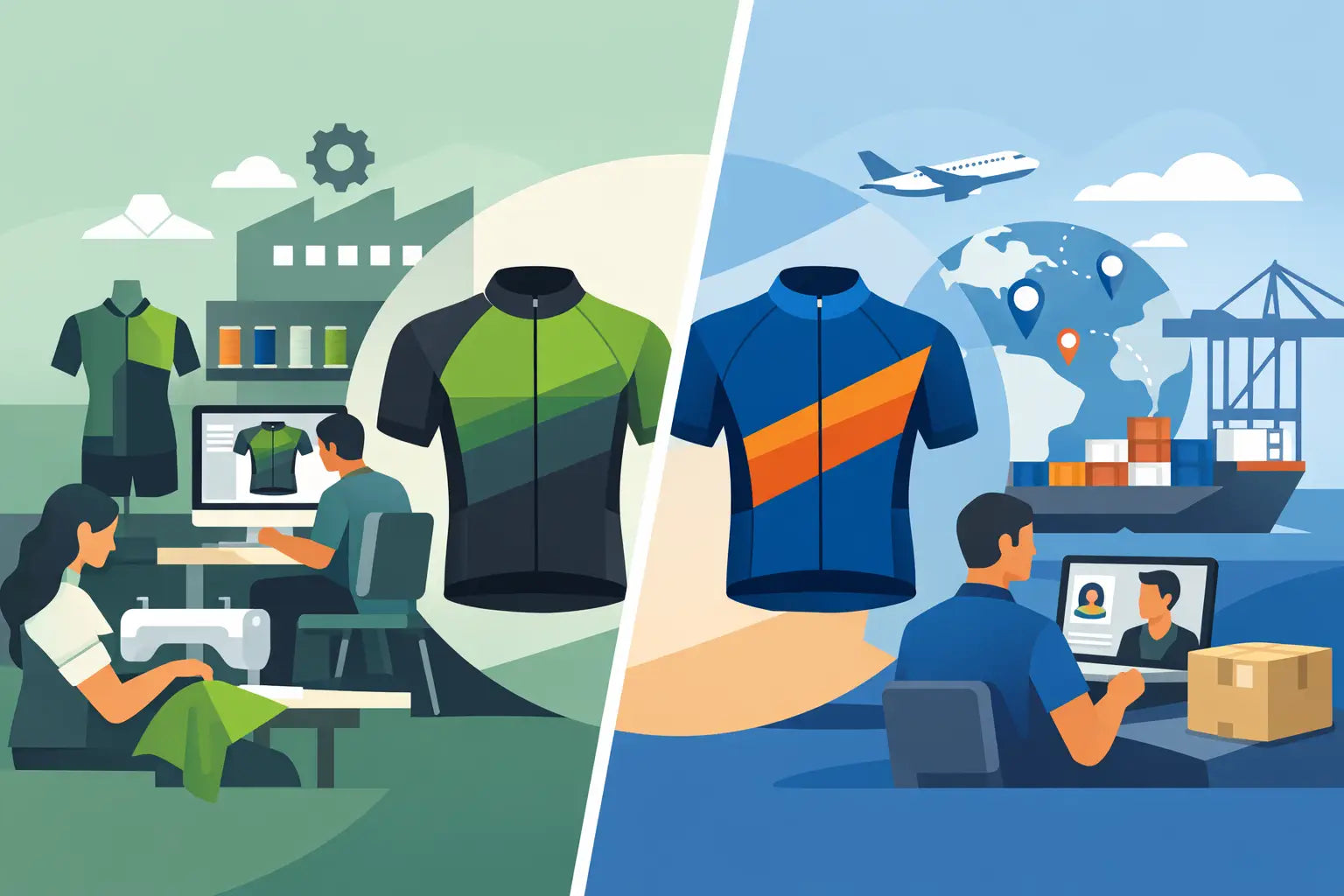
A missed fit approval, a delayed fabric shipment, or a color that lands slightly off can turn a team kit order into a race-week problem. That is why in house production vs outsourcing is more than a manufacturing decision. For cycling clubs, team managers, and riders, it directly affects comfort, consistency, delivery confidence, and how the kit performs when the pace rises.
The right model depends on what you need to control. Outsourcing can offer scale and specialized capacity. In-house production creates a tighter connection between design, development, manufacturing, and quality checks. For performance apparel, where small details make a real difference, that connection matters.
What the Production Model Changes
A cycling jersey is not simply a printed garment. It is a combination of panel shaping, fabric selection, stitch construction, pocket placement, gripper tension, zipper quality, and graphic execution. Bib shorts add another layer of complexity, including compression balance, chamois positioning, strap stretch, and leg cuff retention.
When those stages are managed by separate companies, every handoff introduces potential variation. A brand may create a design in one location, source fabric through another partner, send artwork to a printer, and rely on a third factory for sewing and finishing. This can work well for high-volume, standardized orders. It can also make changes slower and quality issues harder to trace.
An in-house model keeps more of those decisions closer together. Designers can work directly with production teams. Pattern adjustments can be tested faster. Quality teams can review the finished garment against the approved standard before it moves to packing and shipment. The result is not automatically better just because it is in-house, but it gives the manufacturer more direct responsibility for the outcome.
In House Production vs Outsourcing: The Core Trade-Off
The central trade-off is control versus flexibility. In-house manufacturing gives a cycling apparel company stronger control over its production process. Outsourcing gives a company access to outside expertise, capacity, or lower labor costs without building and operating its own factory.
For a team ordering custom kits, the difference becomes visible in practical moments. Can the supplier confirm whether a requested logo placement will affect a seam? Can a fit issue be corrected before a full run begins? Can the team reorder matching jerseys later in the season? Can the supplier explain where a delay occurred and what is being done about it?
With a fully outsourced supply chain, answers may need to travel through multiple layers. That can slow decisions and leave customers working from broad estimates rather than live production information. In-house teams can usually respond with more precision because the people managing the order are closer to the people making it.
That said, outsourcing is not inherently a weak option. A brand that partners with a highly capable specialist factory may produce excellent apparel, particularly when the product range is established and order quantities are predictable. The risk increases when the project requires frequent revisions, unique sizing needs, low minimums, or a deadline that cannot move.
Fit and Quality Need a Short Feedback Loop
Performance fit is where production control earns its value. A race jersey should sit close to the body without restricting breathing or shoulder movement. A bib short should remain stable through hours of pedaling, not bunch, chafe, or lose compression after repeated washes. These standards are shaped by more than a design file.
Fabric behavior changes with weight, stretch direction, finishing, and print process. A pattern that performs well in one material may need adjustment in another. If pattern development, sampling, and manufacturing are separated, resolving those details can take several rounds of communication and weeks of added time.
A connected in-house workflow shortens that loop. The development team can identify an issue, adjust the pattern or construction, and move quickly into another sample or production check. It is especially valuable for custom team programs, where a club may need men’s and women’s fits, youth sizing, skinsuits, vests, winter layers, or triathlon apparel that all carry the same visual identity.
Quality control also becomes more meaningful when it is built into production rather than applied only at the end. Finished-garment inspections are necessary, but they cannot recover every issue created earlier in the process. Checking print alignment, seam quality, measurement tolerances, and component performance during production helps prevent a small deviation from becoming a full-order problem.
Customization Is Easier When Production Is Close
A custom kit needs to look sharp, but the work behind it is technical. Sponsor logos must reproduce cleanly across different sizes. Colors need to remain consistent across jerseys, bibs, jackets, and accessories. Design elements have to work around curved panels, pockets, zippers, and seams.
Outsourced production can limit how much a customer can change. Some factories require rigid templates, larger minimum order quantities, or narrow fabric and color options because their operations are optimized for efficiency. Those limits may be acceptable for a basic club jersey. They are less useful for a team building a complete, professional kit system.
In-house manufacturing makes it easier to coordinate the moving parts. The team managing artwork can understand the construction constraints. The production team can flag when a logo may distort on a stretch panel. Reorders can be checked against prior specifications rather than recreated from scratch.
For organizations, this also supports better ordering experiences. A reliable team store, clear size guidance, and controlled design files help reduce the familiar cycle of late additions, incorrect sizes, and inconsistent kit generations. The factory model alone does not solve administration, but it gives the supplier a stronger foundation to manage it well.
Cost Is More Than the Price Per Jersey
Outsourcing is often chosen for apparent cost savings. An outside factory may quote a lower unit price because it spreads overhead across many clients or operates at very high volume. That advantage can be real, particularly for straightforward products and large orders.
But the lowest quote is not always the lowest total cost. Teams should consider sampling charges, revision cycles, freight, import complexity, minimum order requirements, and the cost of replacing apparel that arrives late or fails to meet expectations. A jersey that is inexpensive but uncomfortable will spend more time in a drawer than on the road.
Factory-direct in-house production can reduce some of those layers by removing middlemen between the brand and the manufacturing floor. It also allows a supplier to make more informed recommendations early, such as choosing a proven fabric or construction method instead of approving a design detail that creates avoidable cost or delay later.
The best question is not, “Which option is cheapest?” Ask, “Which option gives our team the most dependable performance for the budget?” That includes product life, rider satisfaction, reordering ability, and confidence that the kit will arrive when the calendar says it needs to.
Speed Depends on Decision-Making, Not Just Factory Size
A large outsourced factory may have enormous capacity, yet still be slow for a custom order if approvals pass through agents, brand offices, and production schedulers. Conversely, a smaller in-house operation can move efficiently when its teams share the same systems, standards, and production visibility.
Lead times should always be discussed in relation to the full project. Artwork approval, sizing collection, sample review, production scheduling, inspection, and shipping all take time. Teams that begin early have more room to make smart choices. Teams that wait until the race calendar is close need a supplier that can communicate clearly about what is realistic.
This is where manufacturing transparency separates dependable partners from vague promises. A good supplier does not simply offer a delivery date. It explains the approval points that protect that date and raises concerns before they become emergencies.
When Outsourcing May Be the Better Fit
Outsourcing can make sense for brands that need a highly specialized process they do not have internally, such as a particular technical fabric treatment or a product category outside their normal range. It can also be practical for very large, repeatable runs where customization is limited and the supply chain is proven.
The key is accountability. Ask who owns the pattern, who approves fabric substitutions, who performs inspections, and who resolves an issue if the delivered goods differ from the approved sample. If those answers are unclear, the lower price may carry more risk than it appears to.
For custom cycling apparel, CCN Sport’s in-house approach is built around keeping performance decisions close to production. That supports precise customization, controlled quality, and the faster communication teams need when a kit has to look right and ride right.
Choose the Model That Protects Your Ride
The strongest production model is the one that matches your order, timeline, and performance expectations. A simple bulk order may benefit from outsourced scale. A club launching a full kit collection, a development squad needing reliable reorders, or a race team chasing a precise fit often benefits from closer manufacturing control.
Your kit represents the team at the start line, on the podium, and through every hard mile in between. Choose a production partner that treats every panel, seam, and delivery date with the same discipline your riders bring to the road.

Share:
How to Design Triathlon Team Kits That Race Fast
How to Launch Club Apparel That Riders Wear