

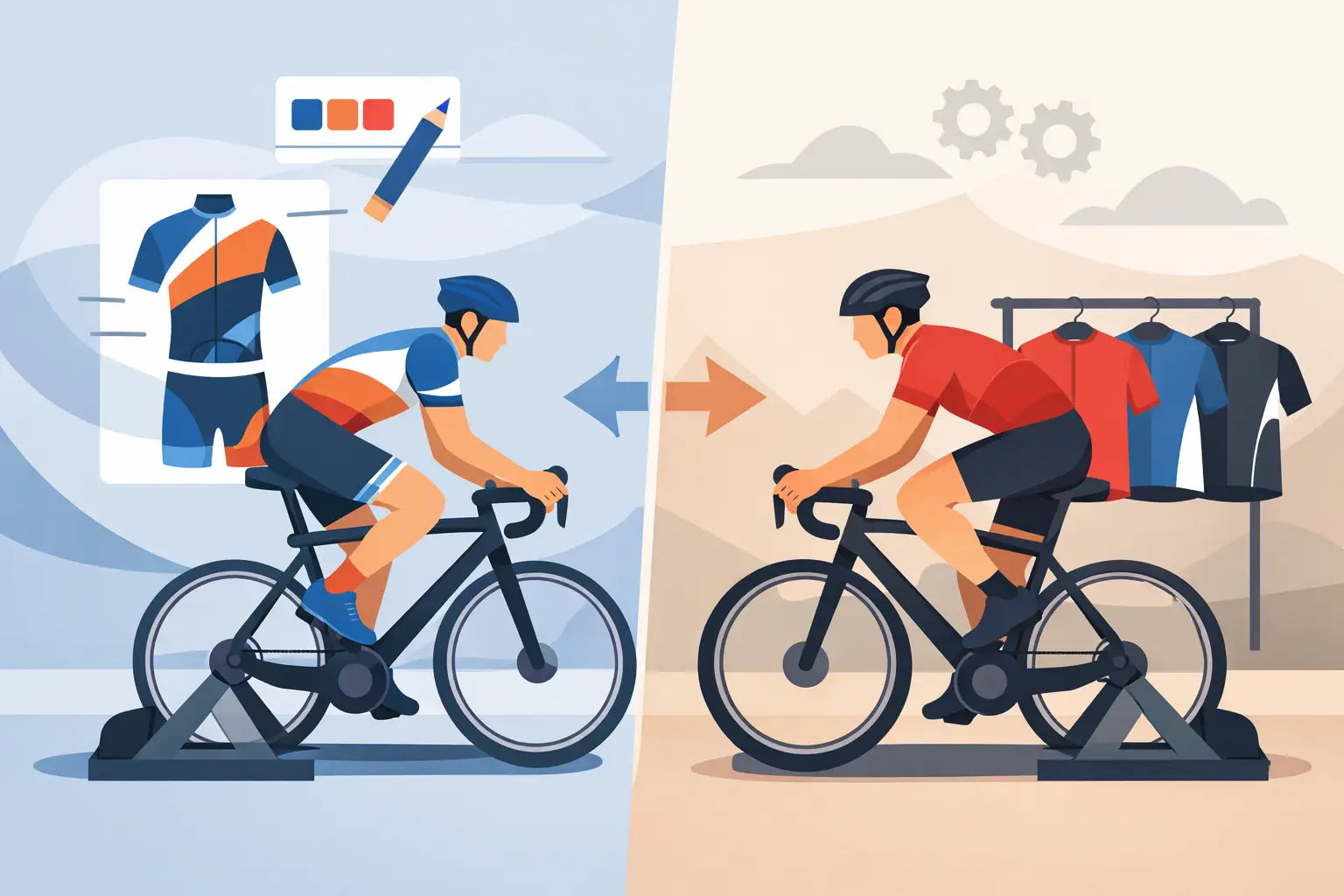
A fast group ride can tell you almost everything about a kit in the first hour. If the jersey pockets sag, the bib straps rub, or the fit starts shifting when the pace lifts, you feel it right away. That is why the custom vs stock cycling apparel decision matters more than most riders think. It is not just about graphics or price. It is about how the kit performs, how it represents the rider or team, and how reliably it shows up when the season starts.
For some cyclists, stock apparel is the obvious answer. It is available now, proven, and easy to buy one piece at a time. For others, custom is the better tool - especially when a club, team, shop, or event needs a unified look with specific performance requirements. The right choice depends on who is riding, how often, and what the kit needs to do.
Custom vs stock cycling apparel: the real difference
At a glance, the difference seems simple. Stock cycling apparel is pre-designed retail gear produced in set colors, styles, and size runs. Custom cycling apparel uses team branding, selected colors, and often a more tailored ordering process built around a group or organization.
But the deeper difference is control. With stock apparel, the brand has already made the design, merchandising, and production decisions. You choose from what is available. With custom apparel, the rider, team manager, or club organizer has more input into the final result, from visual identity to garment selection and, in many cases, practical details like matching warmers, vests, or race-day accessories.
That control matters when consistency matters. A local rider replacing a worn-out jersey may just need dependable retail gear. A race team trying to present a clean, professional image across jerseys, bibs, skinsuits, and outerwear needs something more coordinated.
When stock apparel makes the most sense
Stock apparel is built for simplicity. If you are an individual rider who needs quality gear quickly, retail options are often the most efficient path. You can compare fits, choose based on riding style, and buy only what you need without waiting for a team order window to close.
This is especially useful for riders with changing needs throughout the season. Maybe you need one thermal jacket for winter training, a lightweight jersey for summer climbing, or an extra pair of bib shorts before a race weekend. Stock gear lets you fill those gaps fast.
There is also less operational friction. No design approvals, no collecting teammate sizes, no back-and-forth on logos, and no concern about whether everyone has paid. For solo riders, that convenience is hard to beat.
The trade-off is that stock apparel is built for broad appeal. Even when the fit and fabric are excellent, the design is fixed. You are choosing from a catalog rather than shaping a kit around your exact team identity or event needs.
Where custom apparel pulls ahead
Custom kit starts making more sense the moment a group needs alignment. Clubs, race teams, development programs, event organizers, and shops all benefit from apparel that looks intentional and performs consistently across the roster.
The visual side is obvious. Matching colors, sponsor placement, and a clean design make a team look organized. That matters in competition, but it also matters in community riding, events, and brand building. Riders become more recognizable. Sponsors get proper visibility. The group presents itself with more credibility.
The performance side is just as important. A strong custom program is not only about printing graphics onto a jersey. It is about selecting the right garments for the way the group rides. A crit team may prioritize aerodynamic race jerseys and compressive bib shorts. A gravel event may need more versatile cuts and pocket layouts. A triathlon program needs a different apparel system altogether.
That is where manufacturing experience matters. When custom apparel is handled by a supplier with real in-house production and technical depth, the result is not just personalized. It is built around function.
Fit, comfort, and performance are not separate issues
Cyclists often talk about style and performance as if they are separate categories. On the bike, they are tied together. A jersey that holds its shape at speed, a bib short that supports long hours in the saddle, and a base layer that manages temperature properly all affect comfort and output.
This is one reason the custom vs stock cycling apparel conversation is more nuanced than budget alone. The best stock apparel can absolutely deliver high-level performance. Many riders never need anything else. But custom can offer a better match when a group wants specific cuts, a race-focused fit, or a broader kit system that works together across conditions.
There is an important caveat here. Custom is not automatically better. Poor custom apparel can be disappointing if the supplier lacks technical standards, fit consistency, or production control. Great custom kit comes from a process that starts with proven garment patterns and performance fabrics, then applies the custom design to products that are already built to ride hard.
Budget is part of the equation, but not the whole equation
Price always matters, especially for clubs and team managers ordering at scale. Stock apparel can look more straightforward because you see the retail price and buy as needed. For individuals, that is often the easier financial decision.
Custom apparel works differently. The per-piece value can be very strong for teams, especially when ordering coordinated kits across multiple riders. It can also create better long-term efficiency by reducing the mix of mismatched garments and repeated one-off purchases. If the program includes direct ordering support, size management, and dependable replenishment, that operational value becomes part of the cost picture too.
What teams need to watch is minimums, lead times, and quality consistency. A low headline price means very little if the garments arrive late, the fit is inconsistent, or the fabrics do not hold up through a season of training and racing. Reliable production is part of the value, not an extra.
Speed to delivery changes the answer
If you need apparel for next weekend, stock wins. That is simply the reality. Retail inventory exists to solve immediate needs.
Custom orders require planning. Design approval, production scheduling, and group coordination all take time. For established clubs and teams, that is manageable because kit ordering follows a calendar. For newer organizations, it can be a challenge if apparel is treated as a last-minute task.
This is why experienced custom buyers think beyond a single jersey order. They plan full kit systems before the season, account for new rider additions, and work with suppliers that can support faster, more flexible production. A factory-direct model can make a real difference here because it reduces layers between design, manufacturing, and delivery.
Which riders should choose stock, and which should choose custom?
If you are a solo rider focused on training, weekend group rides, or replacing key pieces throughout the year, stock apparel is often the right answer. It gives you speed, convenience, and dependable performance without requiring a larger process.
If you manage a club, race team, shop program, charity ride, or multisport group, custom is usually the stronger solution. It creates consistency across riders, supports sponsor and brand visibility, and lets you choose garments that reflect how your group actually rides.
There is also a middle ground. Many cyclists use both. They rely on stock pieces for day-to-day training and choose custom kit for team events, racing, and organized riding. That is often the most practical setup because it balances convenience with identity.
How to make the right call on custom vs stock cycling apparel
Start with the riding context, not the graphic. Ask how the apparel will be used, how quickly it is needed, and whether a coordinated look has real value. Then look at the technical side: fit profile, fabric performance, weather range, and durability.
If you are ordering for a team, think like an operator. Can the supplier handle size range needs? Can they support repeat orders? Do they offer low enough minimums to make custom realistic for your group size? Can they deliver race-ready garments, not just printed clothing?
If you are buying for yourself, be honest about what matters most. If your priority is getting proven gear fast, stock is a smart choice. If your priority is riding in a kit that represents your team, sponsors, or personal brand with precision, custom may be worth the added planning.
A strong apparel partner should be able to serve both needs. That matters because riders and teams rarely stay in one lane forever. A club may begin with stock purchases and move into custom as it grows. A racer may train in retail gear and compete in a fully customized setup. Brands like CCN Sport are built for that reality, with both performance retail apparel and custom team systems designed around serious riding.
The best kit is the one that fits the ride, the rider, and the season ahead. Choose the option that performs under pressure and makes sense when the miles start adding up.

Share:
What Great Club Cycling Apparel Gets Right
Custom Triathlon Team Apparel That Performs