

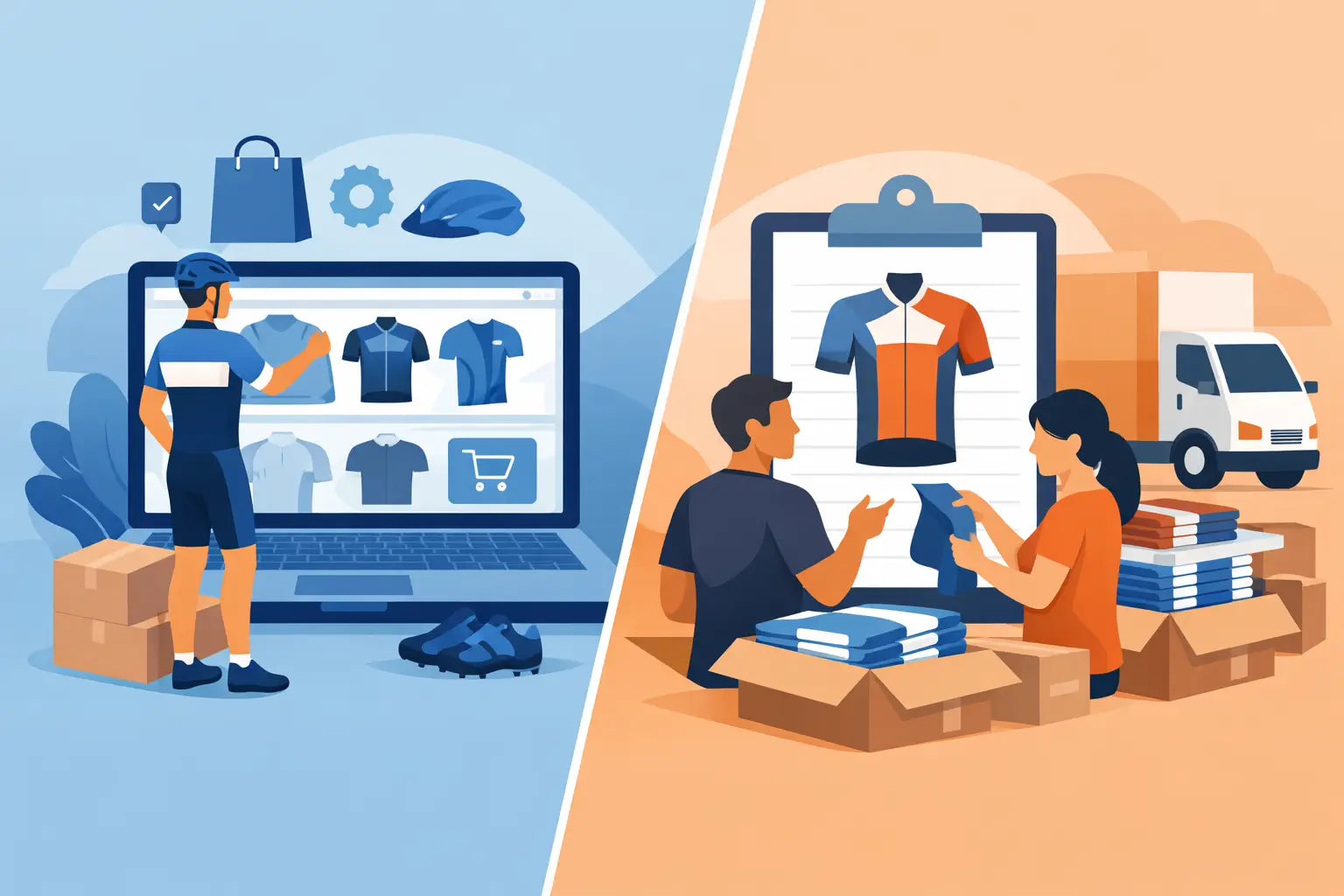
If you have ever chased down 28 riders for jersey sizes, bib short quantities, and late payment before a race deadline, you already know why team store vs bulk ordering is more than a purchasing detail. It affects fit accuracy, cash flow, admin time, reorder flexibility, and how smoothly your club actually gets kitted out when the season starts.
For cycling teams, there is no one-size-fits-all answer. A small elite squad with fixed sponsorship and a locked roster often needs something very different from a large club with new members joining every month. The right model depends on how your team operates, how much control you need, and how much administrative work you want to carry.
Team store vs bulk ordering: what is the real difference?
Bulk ordering is the traditional model. One person, usually a team manager, club officer, or apparel coordinator, collects sizes and quantities from the group, submits one consolidated order, and distributes the kits when they arrive. It is centralized, predictable, and often well suited to teams with a defined roster.
A team store shifts much of that process to the individual rider. Instead of one organizer collecting every detail manually, the team opens a branded online store for a set period. Riders place their own orders, choose their sizes, pay directly, and select from the approved kit assortment. The team still controls the products and artwork, but ordering is decentralized.
That distinction matters because cycling apparel is personal. Fit preferences vary. One rider wants race-cut jerseys and compressive bibs, another wants a more forgiving fit for long club rides, and another only needs a vest and arm warmers. The more variety your team has in rider needs, the more a team store can reduce friction.
When bulk ordering makes the most sense
Bulk ordering still works extremely well in the right setting. If your team has a stable roster, a single budget, and a clear idea of what every rider needs, it can be the fastest way to outfit the group.
This is often the case for elite race teams, development programs, and sponsored squads where the kit package is standardized. Every rider gets the same jersey, the same bib shorts, the same speedsuit, and maybe a jacket or base layer. In that environment, choice is limited by design. Administrative control matters more than individual flexibility.
Bulk ordering can also be useful when the organization is paying for all or part of the apparel. If the club treasurer or sponsor is covering costs, centralizing the order keeps accounting clean. There is one invoice, one approval process, and one shipment to manage.
The trade-off is workload. Someone has to collect every order, confirm sizing, chase responses, track payments if riders are contributing, and deal with inevitable changes after the order is submitted. If the team manager is already juggling race entries, travel, and sponsor obligations, apparel admin can become its own full-time project.
When a team store is the better tool
A team store is built for scale, flexibility, and cleaner administration. For clubs with a broad membership base, it usually solves problems before they start.
Think about a typical cycling club. Riders join at different times. Some want only a short sleeve jersey. Others want a full kit, winter jacket, gloves, and a tri suit. Sizes vary widely, and not everyone is ready to buy on the same day. In that situation, a team store gives riders control while keeping the visual identity of the club consistent.
It also reduces the most common source of ordering mistakes: manual data entry. When riders choose their own garments, sizes, and quantities directly, the risk of the apparel coordinator entering the wrong bib size or missing an item drops significantly.
From an administrative standpoint, that is a major advantage. Instead of managing dozens of individual emails and spreadsheets, the organizer sets the collection, approves the designs, and lets the store handle the transaction side. That means less time spent on follow-up and more time focused on riding, racing, and running the team.
Cost is not just about price per piece
A lot of teams approach team store vs bulk ordering as a simple cost comparison. That is too narrow.
Yes, unit pricing matters. Bulk ordering may look attractive if the team is placing a large, uniform order and maximizing quantity at once. But the real cost includes labor, order errors, overbuying, underbuying, and the need for reorders later.
For example, a bulk order can become expensive if a manager pads quantities to avoid shortages, then gets stuck with extra inventory in unpopular sizes. On the other hand, a team store can prevent dead stock because riders buy exactly what they need.
There is also the cash flow side. In a bulk model, the team often fronts the cost or collects money manually before the order is placed. With a team store, riders typically pay directly during the store window. That can remove a major financial burden from the organizer, especially for clubs without a large operating budget.
So the better question is not Which model is cheaper on paper? It is Which model creates fewer mistakes, less wasted time, and less financial risk for your team?
Fit accuracy and rider satisfaction
Cycling apparel is performance equipment. A jersey that flaps at speed, bib shorts with the wrong compression, or a skinsuit ordered in the wrong size does not just look off. It affects comfort and how the rider performs on the bike.
That is one reason team stores have become so valuable. When riders place their own orders, they can take time to review product descriptions, fit notes, and size guidance based on the garments offered. They are making a personal fit decision instead of replying to a rushed group message with "medium, I think."
Bulk ordering can still work well if the team has already standardized on familiar products and riders know exactly what they wear. But for new clubs, mixed disciplines, or expanded apparel ranges, self-service ordering usually produces better alignment between what is ordered and what riders actually want to wear.
That matters long after delivery. If riders are happy with fit and function, they wear the kit more often. That strengthens team identity and makes the investment work harder.
Reorders, new members, and season changes
This is where the difference between the two models becomes most obvious.
Bulk ordering is strongest when demand is fixed and timed. If your team orders once before race season and everyone is set, great. But many clubs are not that static. New riders join mid-year. Existing members want to replace worn bibs. Weather shifts and suddenly everyone wants thermal gear and vests.
A team store supports that reality much better. It gives teams a repeatable structure for opening additional sales windows without rebuilding the process from scratch each time. For organizations with ongoing turnover or year-round membership growth, that flexibility is hard to beat.
Bulk ordering can handle reorders, but each cycle tends to recreate the same administrative work. If the team is growing, that burden compounds fast.
Which model is better for different types of cycling teams?
For a race team with a fixed roster and sponsor-funded kit package, bulk ordering is often the cleanest option. It keeps product allocation controlled and ensures everyone receives the same setup.
For a club with varied rider needs, mixed abilities, and rolling membership, a team store is usually the more efficient system. It gives each rider choice without sacrificing team consistency.
For many organizations, the smartest answer is hybrid. Use bulk ordering for mandatory race essentials like jerseys and bibs, then run a team store for optional add-ons such as jackets, base layers, casual wear, or mid-season reorders. That approach gives the team control where it matters and flexibility where it helps.
That is often the sweet spot, especially when working with a custom apparel partner that can support both models. Brands with direct manufacturing control, like CCN Sport, are in a stronger position to help teams choose the right structure because they are not forcing every customer into the same process.
How to decide without overcomplicating it
Start with three practical questions. Is your roster fixed or fluid? Is the team paying centrally or are riders buying individually? And how much admin time can your organizer realistically absorb?
If your answers point to fixed numbers, centralized funding, and a standardized kit package, bulk ordering is likely the better fit. If your team has rolling demand, individual purchases, and limited admin bandwidth, a team store will probably save time and reduce friction.
The key is to choose the system that matches how your team actually functions, not how you wish it functioned. A fast ordering process is not just convenient. It protects deadlines, improves rider satisfaction, and makes it easier to keep your team looking sharp in every training ride, race, and club event.
The best kit program is the one riders will actually use without confusion, delay, or compromise - and that starts with picking the ordering model built for your team, not someone else’s.

Share:
How to Size a Skinsuit for Race Fit
Best Cycling Rain Gear for Fast Wet Rides