

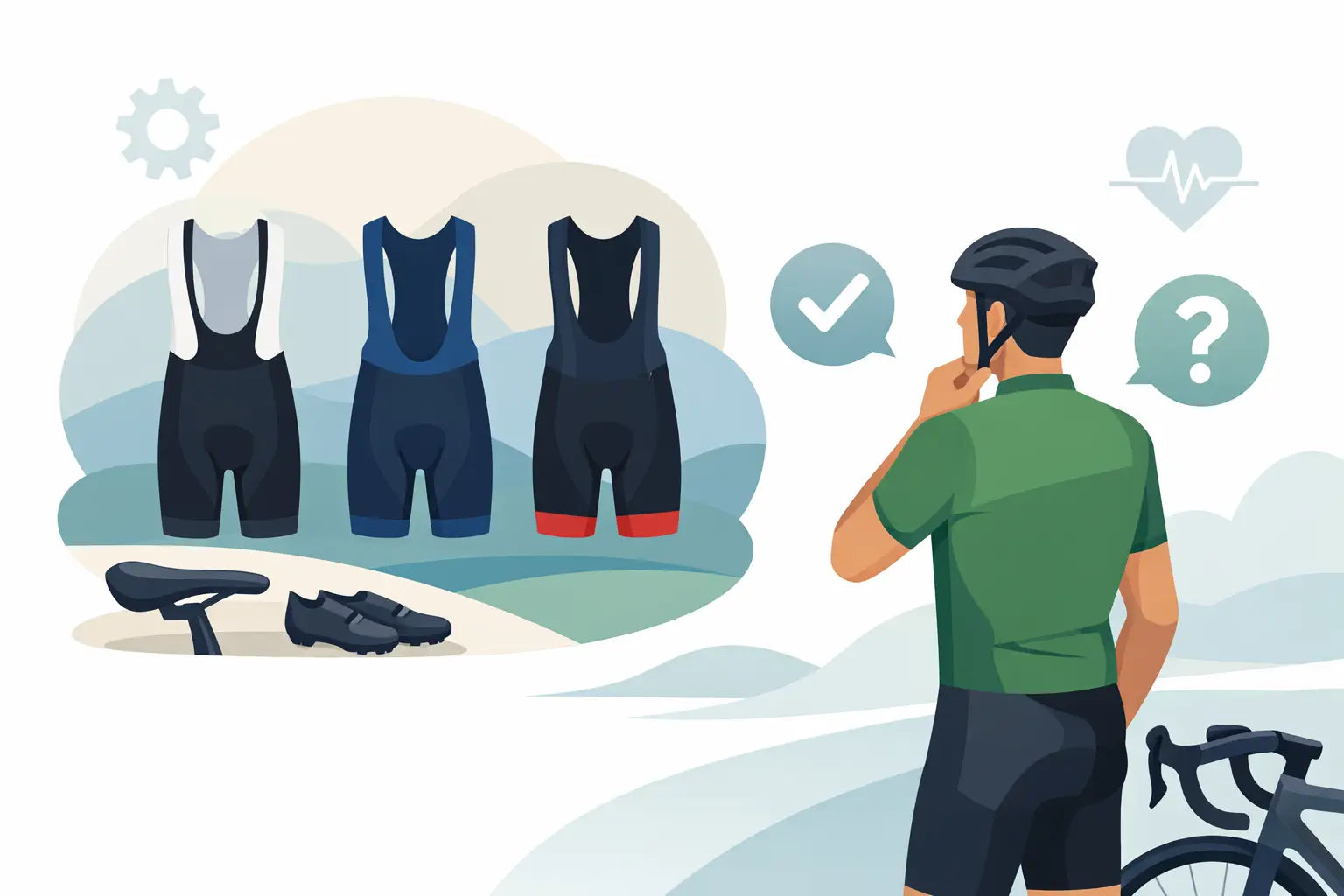
The wrong bib shorts usually reveal themselves about 90 minutes into a ride. That is when a chamois feels too soft or too thick, the leg grippers start creeping, or the straps begin pulling where they should disappear. If you are figuring out how to choose cycling bib shorts, the goal is not simply to find a pair that feels good standing in a mirror. It is to choose a short that stays stable, comfortable, and efficient once the miles start adding up.
Bib shorts are one of the most technical pieces of cycling apparel you can buy. Fit, pad construction, panel layout, compression, and fabric all work together. Get that system right and you can ride longer with less distraction. Get it wrong and even strong legs will not save the day.
How to choose cycling bib shorts for your riding
Start with the kind of riding you actually do, not the kind you imagine doing once or twice a season. A racer doing high-intensity road training needs something different from a club rider logging four-hour weekend miles, and both need something different from a gravel rider dealing with vibration and varied positions.
For road racing and hard training, look for bib shorts with a close, compressive fit, stable leg cuffs, and a chamois that feels supportive rather than plush. Race-oriented shorts usually prioritize muscle support, aerodynamic paneling, and a pad that stays out of the way during sustained efforts.
For endurance road rides, comfort over time matters more than an aggressive second-skin feel. That often means a chamois designed for longer saddle contact, fabrics with a slightly more forgiving hand feel, and straps that remain invisible deep into the ride.
For gravel and mixed-surface riding, vibration management becomes a bigger part of the equation. Some riders prefer a slightly denser pad and a short with excellent stability through the hips and thighs, since shifting terrain can expose poor fit faster than smooth pavement.
If you ride indoors often, breathability can move to the top of the list. Turbo sessions generate a lot of heat and sweat, so lighter fabrics and excellent moisture transfer may matter more than all-day storage or weather protection.
Fit matters more than almost anything else
A premium bib short with the wrong fit will underperform. A well-built short in the correct fit will almost always beat a more expensive option that is too loose, too long, or too restrictive.
Bib shorts should feel snug when you first put them on. That is normal. They are designed to work in a riding position, not while standing upright in your bedroom. The straps should sit flat without digging into the shoulders, and the body of the short should feel supportive across the hips and glutes without creating pressure points.
The legs should stay in place without bunching. If the leg opening rides up easily or the fabric wrinkles behind the knee, the fit is likely too large. If the cuffs pinch sharply or create bulging at the hem, the fit may be too small or the cut may simply not suit your build.
Torso length is one of the most overlooked fit factors. Riders with a longer torso often notice strap tension first. If the straps feel like they are constantly pulling the short upward, the overall size or bib pattern may not be right, even if the leg fit seems correct.
What a good fit should feel like on the bike
On the bike, the chamois should sit exactly where you need it without shifting. The fabric should stay smooth across the saddle area, and the straps should almost disappear. You should not be aware of excess material at the front of the hips or movement through the inseam.
The best bib shorts feel secure, not restrictive. There is a difference. Secure means the short supports your position and stays planted through cadence changes and seated climbing. Restrictive means you are thinking about the garment instead of the ride.
The chamois is the performance center
Most riders shop bib shorts by brand, price, or appearance first. In real use, the chamois makes or breaks the experience. Thickness alone is not the answer. More padding does not automatically mean more comfort.
A strong chamois balances density, shape, and placement. Higher-density foam can provide better long-ride support than a thicker but softer pad that compresses too quickly. A well-shaped chamois should match your riding posture, support the sit bone area, and reduce friction without feeling bulky.
For aggressive road positions, many riders prefer a lower-profile pad that disappears during hard efforts. For endurance use, a pad with better vibration absorption and sustained support may feel better after several hours. That does not mean it should feel like a cushion. Too much bulk can create heat, movement, and pressure.
Pay attention to surface fabric as well. A smooth top layer can reduce friction and improve moisture management. Poor moisture control leads to heat buildup, and heat buildup often becomes discomfort.
One bib short will not cover every rider equally
This is where it depends really matters. Saddle shape, riding position, pelvic structure, and personal pressure points all influence what feels right. A chamois that one rider swears by can feel completely wrong to another. That is not marketing spin. It is the reality of contact points and biomechanics.
Fabric and compression affect comfort and speed
The fabric in a bib short does more than stretch. It controls support, cooling, durability, and how the short behaves after repeated washing and riding.
Good compression helps stabilize muscles and keeps the short anchored. It can also improve the overall feel of the garment at threshold efforts or during long seated climbs. But compression should be even. If support feels strong in the thighs but inconsistent through the hips or seat, the panel design may not be doing enough.
Fabric weight matters too. Lighter materials often feel cooler and faster in hot conditions, but they can be less forgiving if the fit is slightly off. Heavier fabrics may offer a more locked-in sensation and better durability, though they can feel warmer in peak summer heat.
Look for fabric that rebounds well. Once bib shorts lose recovery, they lose stability. That means more movement at the saddle, more friction, and a shorter performance lifespan.
Strap design and panel construction are not minor details
Riders often focus on the lower half of the short and ignore the bib upper. That is a mistake. The straps and upper construction are what keep the chamois positioned correctly when you move.
A good strap design spreads tension evenly, lies flat, and breathes well. Minimal bulk helps under jerseys, especially in warm weather. Mesh uppers can improve ventilation, while more structured uppers may offer a more secure feel. Neither is universally better. It depends on the climate, ride duration, and how much support you like through the torso.
Panel construction affects fit precision. More panels can create a more anatomical shape, but only if they are cut and assembled well. Fewer panels can work beautifully with the right fabric. The real question is whether the short matches the body in motion.
How to choose cycling bib shorts by ride duration
If most of your rides are under 90 minutes, you can prioritize a versatile, performance-focused bib short with moderate compression and a balanced chamois. For two- to four-hour rides, stability and sustained support become more important. For all-day events, the margin for error disappears. Small issues become major ones.
That is why many experienced riders own more than one bib short. One may be ideal for high-intensity training and racing. Another may be better for long endurance days. That is not excess. It is choosing the right tool for the workload.
Price matters, but value matters more
The cheapest bib shorts often cut corners in the places that matter most: pad quality, fabric longevity, strap comfort, and panel accuracy. That usually shows up fast. The most expensive option is not automatically the best either.
The smarter question is whether the short delivers repeatable performance. Does it hold its shape? Does the chamois stay consistent after months of use? Does the fit still feel precise after hard training blocks and frequent washing? That is where real value lives.
Factory-direct performance brands like CCN Sport have helped narrow the gap between elite-level construction and accessible pricing, which is good news for individual riders and teams alike. Better bib shorts are no longer reserved for only the top end of the market.
A few mistakes worth avoiding
Sizing up for comfort usually backfires. Bib shorts should feel supportive, and a loose short moves more at the saddle. Choosing based only on pad thickness is another common miss. So is buying a race-cut short for casual endurance use when what you really want is all-day comfort.
It is also easy to overlook your jersey and base layer setup. If the bib upper traps heat or clashes with the rest of your kit, the whole system suffers. Performance apparel works best when each piece supports the others.
The right bib shorts should make the ride feel quieter. Less shifting, less friction, less thinking about contact points. That is the standard worth chasing. Choose for your position, your duration, and your real riding, and the best pair will prove itself long after the first try-on.

Share:
Why Use Custom Teamwear for Cycling
Custom Apparel for Cycling Clubs That Performs