

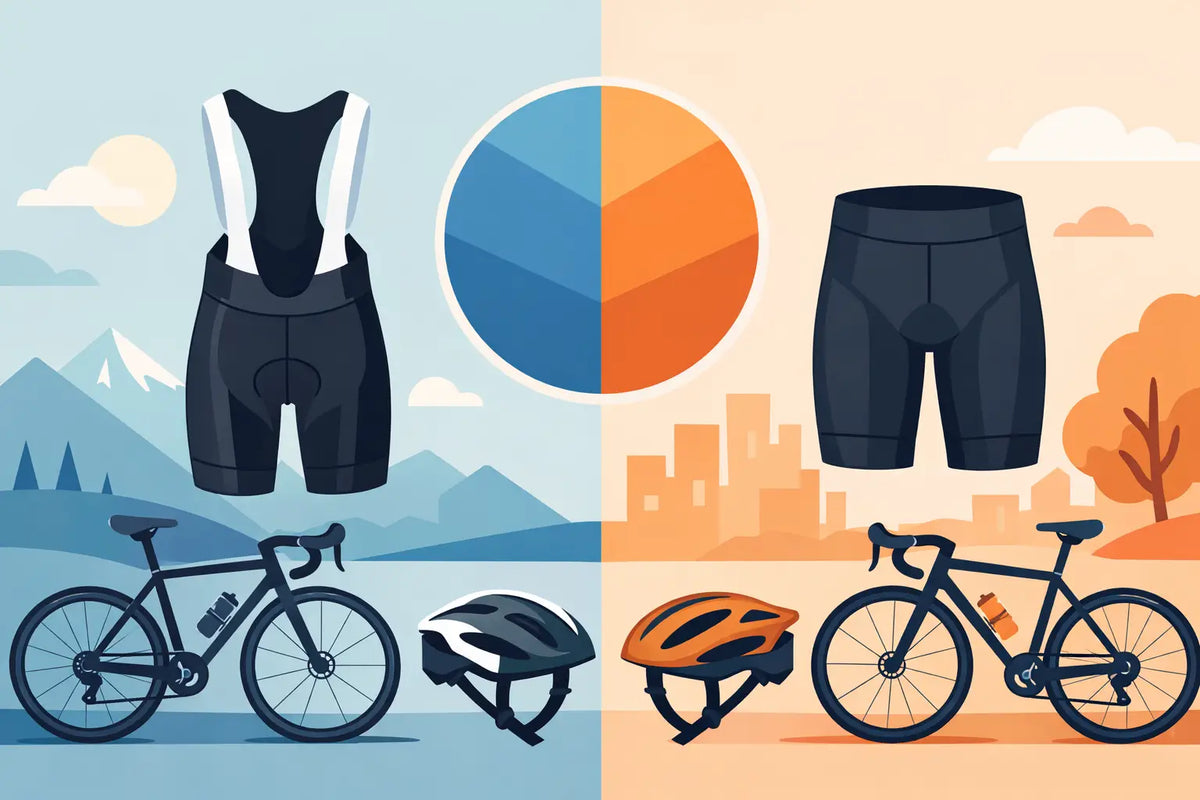
The bib shorts vs cycling shorts decision becomes obvious about two hours into a hard ride. If your waistband is pressing into your stomach, your chamois is shifting, or your jersey keeps riding up, the wrong lower-body layer can distract from every pedal stroke. The right one should disappear beneath you, leaving you free to focus on the group ride, the breakaway, or the next climb.
For most road riders, racers, and endurance athletes, bib shorts deliver the more stable and performance-focused fit. Waist cycling shorts still earn their place, especially for shorter rides, gym sessions, commuting, and riders who prefer a simpler on-and-off routine. The best choice depends on how you ride, how long you ride, and how precisely the garment fits your body.
Bib shorts vs cycling shorts: the core difference
Bib shorts use shoulder straps to hold the short in position. Instead of relying on an elastic waistband at the midsection, the bib upper distributes support across the shoulders and torso. This keeps the chamois closer to the body and reduces pressure around the waist when you are bent over the bars.
Cycling shorts, sometimes called waist shorts, stop at the waist and use an elasticized waistband to stay in place. They have the same essential lower-half construction as bib shorts: a fitted leg, a chamois pad, and leg grippers. A quality pair can be highly effective, but the waistband changes how the garment feels in a riding position.
Neither option is automatically better in every situation. A well-made waist short is more comfortable than a poorly fitted bib, every time. Fit, fabric recovery, panel construction, and chamois placement still matter more than the label on the product.
Why bib shorts are the performance standard
Bib shorts are common in the peloton for practical reasons. The straps keep the short anchored as a rider changes position, stands to climb, sprints, and reaches deep into an aerodynamic posture. That stability helps prevent the chamois from creeping forward, folding, or creating friction where you do not want it.
The absence of a waistband is another major advantage. On a long ride, a tight waistband can feel restrictive across the stomach, particularly when breathing hard or riding in a low position. Bib straps remove that concentrated pressure. The result is a cleaner, more supported feel that many riders notice immediately on rides beyond 90 minutes.
Modern bibs also create a more consistent jersey interface. A jersey sits over the bib upper, so there is less chance of a gap opening at the lower back when reaching for bottles or moving around on the bike. For racing and fast club rides, that cleaner silhouette is not only more polished but can also reduce fabric movement in the wind.
High-quality bib shorts should use light, breathable straps with enough stretch to stay flat against the body. They should support the short without pulling at the shoulders. If straps feel tight while standing, they can become uncomfortable after hours on the bike. The best bib uppers provide support you barely notice.
Bib shorts work best for long and focused rides
If your riding includes endurance training, road racing, gran fondos, triathlon training, gravel events, or frequent club rides, bib shorts are usually the stronger choice. These are the conditions where chamois stability and unrestricted breathing become more valuable as fatigue builds.
They are also a strong option for riders who spend significant time in an aggressive road position. The deeper the hip angle, the more noticeable a restrictive waistband can become. Bibs are built to follow that position.
When waist cycling shorts make more sense
Waist cycling shorts remain a practical piece of performance kit. They are quick to put on, easy to remove, and often more convenient for riders who need frequent restroom stops. That convenience can be particularly meaningful on casual rides, tours with regular breaks, or mixed workouts that combine cycling with strength training.
They can also work well for shorter sessions. For an indoor trainer ride, a 45-minute recovery spin, a commute, or a quick mountain bike loop, a well-fitted waist short can provide all the padding and mobility needed without the extra upper construction of a bib.
Some riders simply prefer the feel of a waistband. This is especially true when the shorts use a wide, soft, low-compression band that stays flat rather than rolling or digging in. Preferences are personal, and comfort is a performance metric. A rider who feels good in their kit is more likely to hold position, pedal efficiently, and stay focused.
The trade-off is that waist shorts can move more at the torso during hard efforts. They may also create pressure at the midsection, particularly if the waistband is too small or sits at an awkward point on the body. This does not mean every waist short is restrictive. It means sizing and construction need closer attention.
The chamois matters more than the straps
Whether you choose bibs or waist shorts, the chamois is the part doing the most demanding work. It manages pressure between the rider and saddle, reduces friction, and supports the body through thousands of pedal revolutions. A premium short with an unsuitable chamois is still the wrong short for the ride.
Look for a chamois designed for your expected duration and riding posture. A thin, flexible pad may feel excellent for fast racing and short training rides. For longer endurance days, riders often benefit from multi-density foam that provides more support beneath the sit bones while remaining low-profile through the center.
Placement is just as critical as thickness. The pad needs to sit directly where your body contacts the saddle in your normal riding position. If it bunches, feels too wide, or shifts while pedaling, changing from waist shorts to bibs will not solve the underlying fit problem.
Do not wear underwear beneath padded cycling shorts. Seams, moisture, and fabric movement can create hot spots quickly. Wear the short directly against the skin, use chamois cream when needed for long or hot rides, and wash the garment after every session.
Fit checks before you commit
A cycling short should feel snug while standing and natural once you settle into a riding position. Loose fabric around the crotch, seat, or thighs is a warning sign. It can lead to chafing and allow the chamois to move when you pedal.
Leg grippers should hold the short in place without leaving painful marks or pinching the thigh. The hem should not ride upward during a few deep knee bends. With bibs, the straps should lie flat without twisting and should not pull the chamois excessively upward.
Pay attention to the panel layout and fabric compression, too. Fewer, carefully shaped panels can reduce seams in high-friction areas. Compression should feel supportive rather than constricting. A race fit is meant to be close, but it should never numb your legs or limit full hip movement.
For teams, consistent sizing becomes even more important. A custom kit should preserve the same technical priorities as retail gear: stable chamois positioning, dependable fabric recovery, secure leg finishes, and a cut that matches the intended discipline. A race-oriented road team may prioritize a compressive aerodynamic bib, while a recreational club may prefer a more forgiving endurance fit.
Weather and layering change the equation
In warm conditions, bib shorts can feel surprisingly airy when built with lightweight mesh straps. The open upper allows heat to escape, while the lower section remains stable during hard efforts. For hot race days, that combination is difficult to beat.
In cooler weather, bibs create a better foundation for layering. Bib tights and thermal bib shorts stay connected through the torso, helping prevent drafts at the lower back. A base layer can sit smoothly beneath the bib upper, and a jersey or jacket can layer over it without a bulky waistband stack.
Waist shorts are not excluded from cold-weather riding, but they can leave a more noticeable break between layers. For mild temperatures or short rides, that may not matter. For long winter base miles, it often does.
Choose the short that lets you forget it is there
Choose bib shorts if you want maximum stability, a pressure-free waist, and a race-ready feel for longer rides. Choose waist cycling shorts if convenience, simple layering, or shorter sessions are your priority. In both cases, buy for your riding position and real ride duration, not just the distance you plan to cover on an ideal day.
The strongest kit earns its place when the road gets rough, the pace rises, and you stop thinking about what you are wearing. That is the standard CCN Sport builds toward: precise fit, dependable comfort, and performance that stays with you through the final mile.

Share:
Winter Cycling Kit Guide for Cold-Weather Speed
Cycling Apparel for Hot Climates That Performs