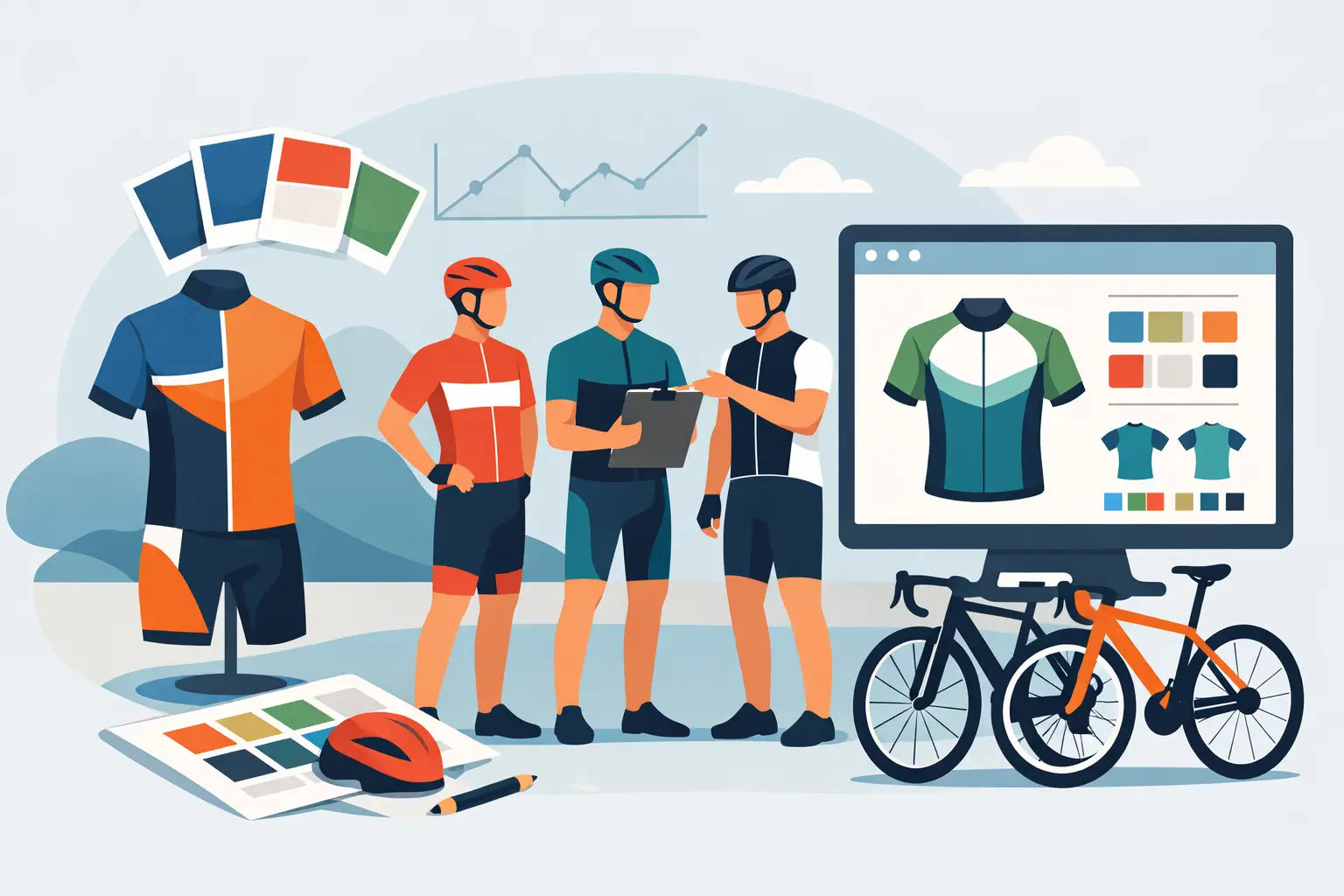
A team kit usually gets judged in the first 10 seconds. Riders look at the design. Managers look at the price. Then the real test starts after a few hard rides, a long wash cycle history, and one race day where fit, fabric, and delivery timing all matter at once.
That is why buying custom cycling team kits should never come down to graphics alone. The strongest kits look sharp, hold their shape, stay comfortable deep into the ride, and arrive on schedule without turning team ordering into a second job.
What good custom cycling team kits actually need to do
A custom kit is not just branded apparel. It is performance equipment with a team identity built into it. If the jersey pockets sag, if the bib straps twist, or if the chamois breaks down mid-season, the design stops mattering very quickly.
For race teams, fast club riders, gravel groups, and tri squads, the baseline is simple. The kit needs to fit a range of body types, stay stable under effort, manage heat well, and keep delivering after repeated wear. That sounds obvious, but this is where many team orders fall short. A supplier may offer attractive mockups while relying on generic cuts, limited fabric options, or outsourced production that makes quality less predictable.
The best custom cycling team kits balance four things at the same time: aerodynamic efficiency, long-ride comfort, visual consistency, and dependable fulfillment. If one of those slips, the whole program gets harder to manage.
Start with fit before design
Most teams want to talk colors first. That is understandable, but fit should lead the conversation.
A high-performance jersey for aggressive road racing should not fit the same way as a club jersey built for mixed weekend rides. A skinsuit for short-course speed has very different requirements from an endurance bib short intended for all-day events. Even within one team, rider expectations can vary. Some want a second-skin race cut. Others need a more accommodating profile that still looks clean on the bike.
That is why custom cycling team kits work best when the supplier offers clear fit categories and product options instead of forcing every rider into one pattern. A race-ready cut can save watts and reduce flap at speed, but it also needs enough pattern precision to avoid restriction across the shoulders and hips. A more relaxed cut may suit larger club orders better, especially when the team includes newer riders, mixed disciplines, or broad age ranges.
If you are managing a team buy, ask the practical questions early. How does the sizing run? Are men’s and women’s options truly developed for different fit needs? Are there product tiers that let the team choose between entry-level and elite construction? Those details affect rider satisfaction far more than a rendering on a screen.
Fabric and construction decide how the kit feels at mile 60
A custom jersey can look premium online and still feel average on the road. The difference usually comes down to fabric selection and construction methods.
Technical fabrics should be chosen for the job they need to do. Lightweight body panels help with heat management in warm conditions. More compressive materials can improve support and stability. Textured sleeves may support aerodynamic performance, while reinforced pocket construction helps preserve shape when riders load nutrition, tools, and layers.
Bib shorts deserve even closer scrutiny. For many riders, the bib short is the real make-or-break piece in any custom order. Panel layout, leg gripper tension, strap comfort, and chamois quality all matter. A lower-priced option might be enough for short training rides or event kits. For teams logging serious volume or racing regularly, better materials and a proven pad are usually worth it.
Durability matters too. Team kits get washed hard and worn often. Colors need to stay consistent. Fabrics need to recover. Stitching needs to hold under repeated stress. If a supplier cannot maintain quality through the season, the lower upfront cost often becomes expensive later.
Design should support identity, not fight performance
Strong kit design does two jobs. It gives the team a recognizable presence, and it works with the garment rather than against it.
That means understanding how artwork sits across seams, pockets, side panels, and different sizes. Fine details that look sharp on a desktop proof can become cluttered once they are scaled across multiple garments. High-contrast layouts may increase visibility, but they also need to remain clean and readable from a distance. Sponsor placement has to respect both brand exposure and garment function.
There is also a practical trade-off between bold design and longevity. Trend-driven graphics can create impact for one season. A cleaner system often lasts longer and makes reorders easier for growing clubs and development teams. The right answer depends on the group. A one-off event kit can take more creative risk. A club that plans to reorder for years usually benefits from a more stable visual identity.
Experienced custom providers understand this balance. They guide teams toward artwork that performs well in production, not just on a mockup.
The ordering process matters more than most teams expect
The bigger the group, the more valuable a clean ordering system becomes.
This is where custom projects often get delayed. Riders miss deadlines. Size changes come in late. Team managers end up chasing payments, edits, and one-off requests. Even if the apparel itself is strong, a messy order workflow can make the entire project frustrating.
A reliable custom program should reduce that burden. Clear product selection, organized sizing support, firm production timelines, and team-specific ordering tools all help. Low minimums can also be important, especially for newer clubs, niche disciplines, or brands testing small runs before scaling up.
Factory-direct production is a real advantage here. When design, manufacturing, and fulfillment are handled in-house, communication is tighter and lead times are easier to manage. It also creates more room for flexibility if a team needs a specific fabric package, race cut, or reorder plan. That is one reason many clubs and organizations work with partners like CCN Sport at https://www.ccnsport.com when they need performance-driven custom apparel without the drag of traditional middleman sourcing.
Not every team needs the same kit program
This is where smart buying beats generic buying.
A local club may need a broad range of sizes, approachable pricing, and a straightforward reorder path for new members. A competitive road team may care most about aerodynamic cuts, elite bib construction, and race-day consistency across the roster. A gravel team may prioritize versatility and durability. A triathlon group has another layer of performance needs entirely, especially around suit construction, drying speed, and discipline-specific fit.
That is why the best custom apparel conversations start with how the kit will actually be used. Is this primarily for training, racing, events, or sponsor visibility? Will riders be in peak summer conditions, mixed climates, or a full-season calendar that includes winter layers? Are you building a premium program for serious athletes, or do you need a range that serves both committed racers and newer members?
It depends on the team, and the supplier should be able to adapt instead of pushing a one-size-fits-all package.
What to ask before placing an order
Before approving any custom kit project, it helps to pressure-test the essentials.
Ask how the garments are constructed and where they are produced. Ask what separates one jersey or bib option from another. Ask how sizing is handled for men and women, what the reorder process looks like, and how production timelines are managed during peak season. If speed matters, ask directly about turnaround. If performance matters most, ask which products are race-focused and why.
Also ask what happens after delivery. Teams grow. Riders crash. Rosters change. New sponsors come in. A custom program should support reorders and future development, not just the first shipment.
That long view is often what separates a transactional vendor from a true apparel partner.
The right kit should feel fast, organized, and repeatable
Great custom cycling team kits do more than make a team look unified. They remove friction. Riders trust the fit. Managers trust the process. The kit performs the way it should, whether the day is a hard road race, a gravel event, or a long club ride in bad weather.
That is the standard worth buying for. When performance, comfort, and ordering reliability are built into the same program, the team spends less time fixing problems and more time riding in gear that feels ready for the work ahead.

Share:
Go-For-Gold Riders Conquer the Storm at ATTCK UNRSTRKTD MONSOON Race
Low Minimum Custom Cycling Jerseys That Perform