

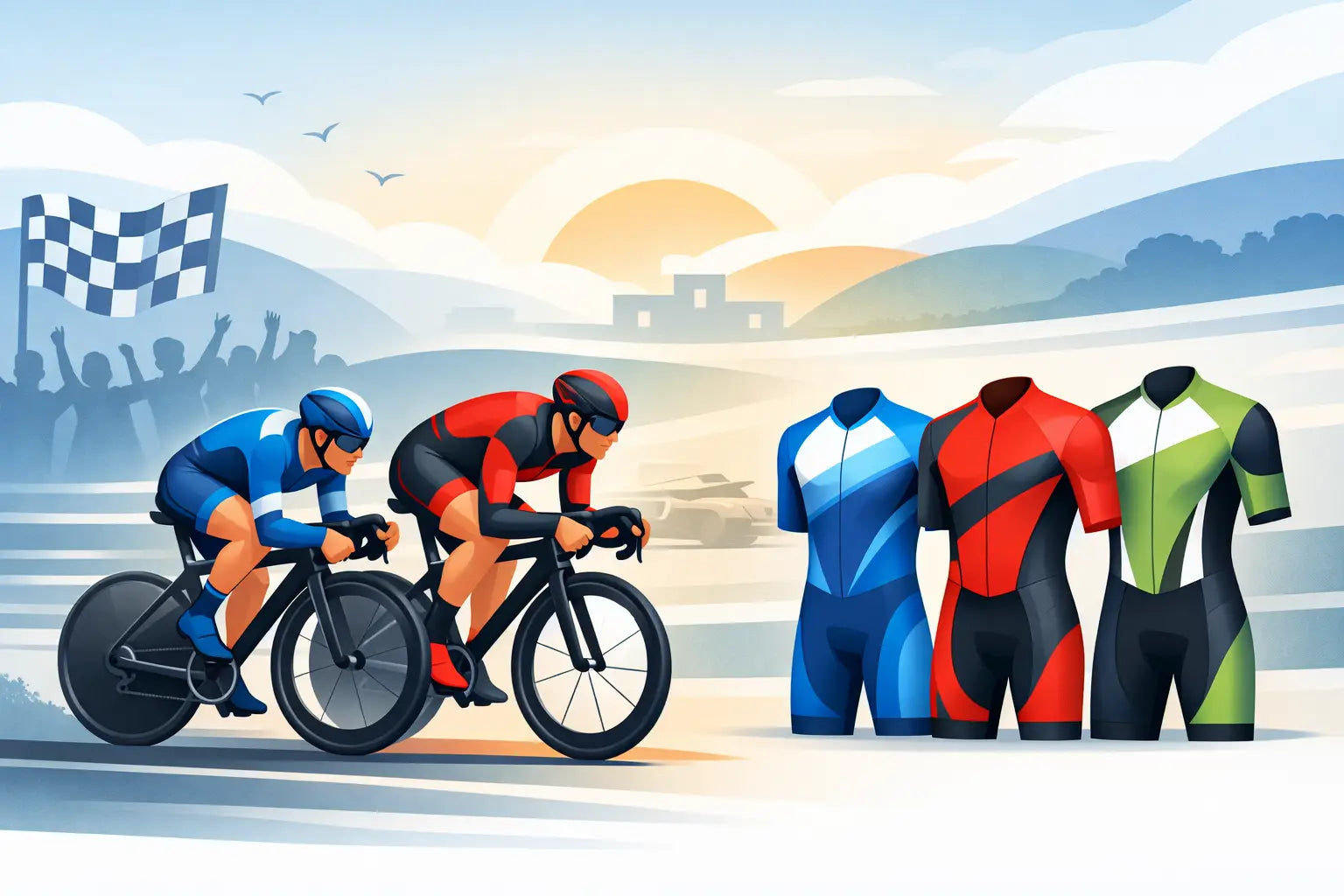
Seconds get expensive when your kit fights you.
That is the real standard for custom race day skinsuits. They are not just about looking unified on the start line. They need to stay stable at speed, support an aggressive position, manage heat under pressure, and still feel right deep into the race. For teams, clubs, and competitive riders, the difference between a good skinsuit and a fast one usually comes down to details you notice only after the gun goes off.
What custom race day skinsuits need to do
A race-day skinsuit has one job: reduce drag without creating new problems. That sounds simple, but performance comes from balance. If the fit is too compressive, breathing and mobility can suffer. If it is too relaxed, fabric moves in the wind and costs speed. If the pad is built for all-day comfort rather than race intensity, it can feel bulky in a low position.
The best custom race day skinsuits are built around the demands of high-output riding. That means close, stable patterning through the shoulders and torso, sleeves that stay planted without bunching, and fabrics chosen for both airflow and surface efficiency. It also means practical race features such as secure pocket construction, clean leg finish, and a zipper setup that works when effort is high and time matters.
For teams, customization adds another layer. You are not only fitting one rider. You are fitting a roster with different body shapes, event types, and expectations. That is why manufacturing experience matters as much as design freedom. Great graphics on the wrong platform do not race well.
Fit comes first, even before aerodynamics
Aerodynamics gets most of the attention, but fit is where performance starts. A skinsuit that matches the rider's position on the bike will almost always outperform one with premium fabrics but poor patterning.
The reason is simple. Drag reduction depends on stability. When material wrinkles across the chest, lifts at the sleeves, or shifts at the lower back, the suit stops working as intended. A precise fit keeps the garment quiet against the body, especially in sustained race posture. That is where real gains show up.
There is also a comfort trade-off to manage. Time trial riders, crit racers, road racers, and triathletes do not all want the same fit profile. A more aggressive cut can feel excellent in a tucked position but restrictive during long road races with frequent movement. A club or team ordering custom skinsuits should think carefully about primary use instead of asking one garment to cover every possible scenario.
Why body position matters
Race apparel should be evaluated on the bike, not standing in front of a mirror. Riders spend race efforts with bent elbows, a rotated pelvis, and a stretched upper body. A skinsuit designed around that posture will often feel unusual when standing upright, but correct once the rider is in position.
That is why experienced sizing support and tested race patterns are so valuable. They reduce guesswork and help teams avoid the common mistake of choosing a size based only on casual fit preference.
Fabric selection changes how a skinsuit races
Not all technical fabrics solve the same problem. Some prioritize compression. Some improve cooling. Some are chosen for surface texture and airflow behavior at speed. The strongest race-day garments combine these properties by zone rather than relying on one material everywhere.
Sleeves are a good example. They often benefit from fabrics engineered to reduce turbulence while maintaining a locked-in fit. The torso may need a different textile that breathes well under full effort and handles sweat effectively. Lower-body panels need enough structure to stay supportive without restricting pedal motion.
This is where race-ready construction separates itself from standard club kit. A skinsuit should feel engineered, not just assembled. Seam placement, panel shaping, and fabric transitions all affect how the garment performs over the course of an event.
Heat management is part of speed
Aero matters, but overheating costs more than most riders expect. In hot races, a skinsuit that traps heat can become a liability even if it tests fast in controlled conditions. The right build needs to account for airflow, moisture movement, and the intensity of the target event.
That is especially important for riders doing long breakaway efforts, summer road races, and high-output triathlon bike legs. The fastest option on paper is not always the fastest after an hour of hard racing in real conditions.
Customization should improve the result, not complicate it
One of the biggest advantages of custom race day skinsuits is control. Teams can align branding, rider identity, sponsor placement, and technical choices in one product. But more options do not automatically mean a better outcome.
The smartest custom process starts with the performance platform. Once the fit and construction are right, the visual design can be built around it. Sponsor logos need to sit cleanly across seams and stretch zones. Colors should work with the underlying panel layout. Even print execution matters, because heavy or poorly handled graphics can affect stretch and feel.
For team managers, this is where in-house production makes a difference. It shortens feedback loops, improves consistency, and makes it easier to solve issues before they become race-week problems. It also helps when you need practical flexibility, such as low minimums, rider-specific sizing, or a repeat order on a tight schedule.
CCN Sport has built its custom program around that reality: pro-level apparel, direct factory control, and a process designed to serve both elite teams and growing clubs without unnecessary friction.
What teams should check before ordering
A skinsuit may look sharp in a mockup and still miss the mark on race day. Before approving any custom order, teams should pressure-test the fundamentals.
Start with the intended use. A suit for criteriums may prioritize aggressive fit and minimal drag, while a suit for road racing may need a slightly broader comfort range and more practical storage. Then look at size coverage. Strong suppliers do not just offer a chart - they help teams match riders to the right cut with confidence.
Ask about pad options, fabric mapping, and lead times. Those are not small details. They directly affect rider satisfaction and event readiness. Durability matters too. A race garment must hold shape, maintain print quality, and keep its fit after repeated use, travel, and washing.
Finally, review the ordering experience. Teams rarely fail because of one jersey or one skinsuit. Problems usually come from poor coordination, unclear approvals, or production systems that are too rigid for real-world team needs.
Riders notice the small details when the race gets hard
By mile one, most skinsuits feel fine. By the final hour, weak points become obvious.
A zipper that bulges in the drops. Leg grippers that start to creep. A pad that feels right on easy training rides but becomes intrusive at threshold. Sleeve bands that tighten too much in the aero position. These are not cosmetic complaints. They affect focus, efficiency, and confidence.
That is why serious riders tend to value predictability as much as speed. They want a skinsuit that disappears once the race starts. No adjustment. No distraction. Just stable fit and consistent function under load.
For clubs moving into higher-level events, this is often the moment custom apparel becomes more than a branding exercise. A well-built skinsuit helps riders feel prepared, unified, and supported by equipment that matches the level they are trying to reach.
The best custom race day skinsuits are built around real use
There is no single perfect skinsuit for every rider or event. That is the honest answer. The right choice depends on race format, climate, rider position, fit preference, and the level of customization a team actually needs.
But the core standard stays the same. Custom race day skinsuits should be fast, stable, breathable, and durable. They should reflect your team identity without compromising performance. And they should come from a process that is reliable enough to support race schedules, roster changes, and repeat orders without drama.
When a skinsuit is built correctly, riders stop thinking about the garment and start focusing on the result. That is exactly where race apparel should put them.

Share:
Custom Teamwear Buying Guide for Cyclists
Are Aero Jerseys Worth It for Cyclists?