

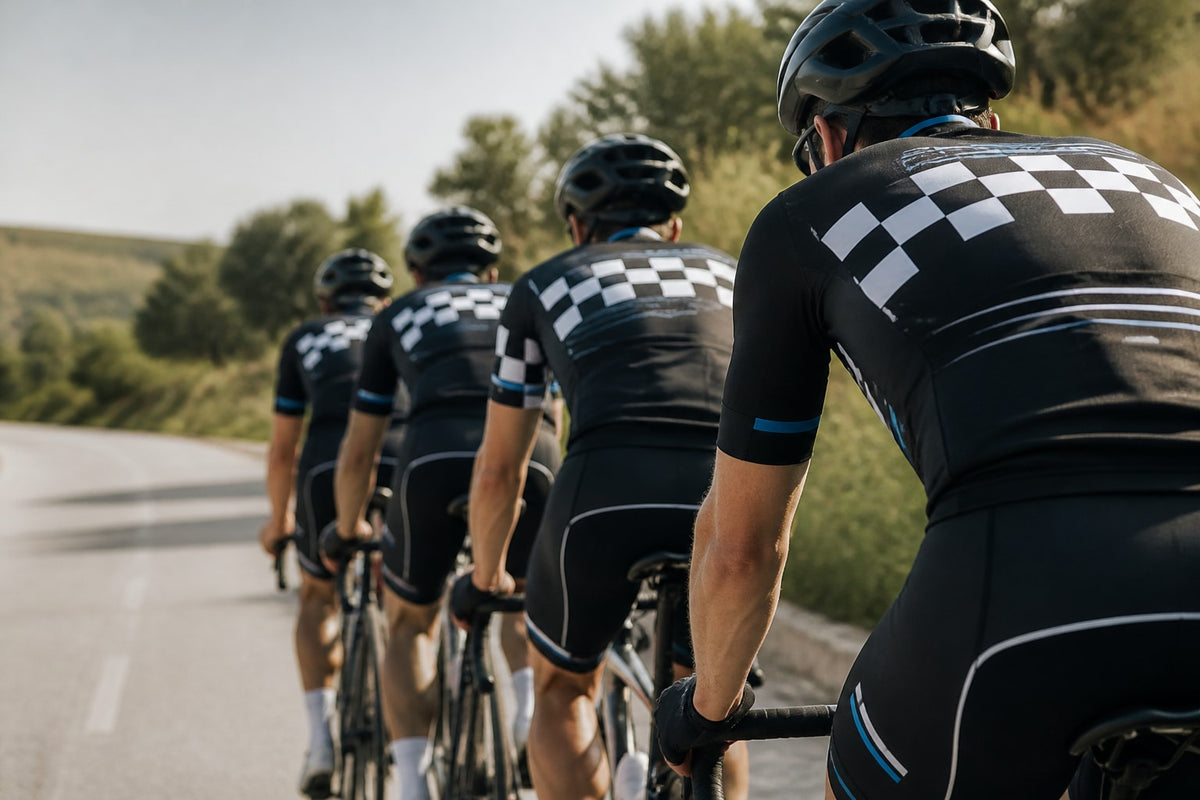
The right jersey for biking is a close-fitting, moisture-wicking top with rear pockets, a full or half zipper, and a cut matched to your discipline and the temperature you ride in. For teams and clubs, the decision carries extra weight: the jersey has to perform for every rider, fit a range of body types, and look consistent across the whole squad.
This guide moves from the basics to the specifics. It covers what separates a cycling jersey from ordinary athletic wear, how to match fabric and fit to conditions, and how to order matching kits for a team without costly mistakes.
What Makes a Cycling Jersey Different From a Regular Shirt?
A cycling jersey is built for a rider in a forward-leaning position, with features that a standard athletic shirt does not have. These details exist to solve problems that appear only after hours in the saddle.
- Longer rear hem: The back panel sits lower so it stays covered when you are bent over the bars.
- Rear pockets: Three pockets across the lower back carry food, a phone, a spare tube or a rain layer without swinging around.
- Zipper: A full zip allows fast ventilation on climbs, while a shorter zip saves weight.
- Gripper hem: A silicone band stops the jersey from riding up.
- Close cut: Fabric that flaps in the wind creates drag and chafes, so race jerseys sit tight to the body.
Cotton tees fail on all of these counts. Cotton holds sweat and dries slowly, which is why synthetic fabrics are the standard in cycling. As BIKE Magazin notes, lightweight synthetic fabrics with an open weave, or fine merino blends, help wick moisture and allow airflow, while cotton absorbs moisture and dries slowly.
Which Jersey Type Suits Your Discipline?
Road, mountain bike and gravel jerseys differ in cut, fabric weight and pocket design, so the discipline you ride should set your starting point.
| Discipline | Typical fit | Key features |
|---|---|---|
| Road racing | Close, aerodynamic | Light fabric, three rear pockets, long hem |
| Gravel | Slightly relaxed | Durable fabric, deeper pockets, sun coverage |
| Mountain bike | Looser, longer | Abrasion-resistant panels, longer sleeves, breathable mesh |
| Time trial and track | Skin-tight | Aero seams, minimal bulk |
Road kit rewards a precise fit, since airflow over fabric costs watts at race speeds. Mountain bike kit trades some of that precision for freedom of movement and protection from branches and crashes. If your club runs both road and off-road programs, specify two cuts rather than forcing one pattern to cover everything. CCN Sport covers the off-road side in its guide to a custom mountain biking jersey.
How Do You Choose the Right Fabric?
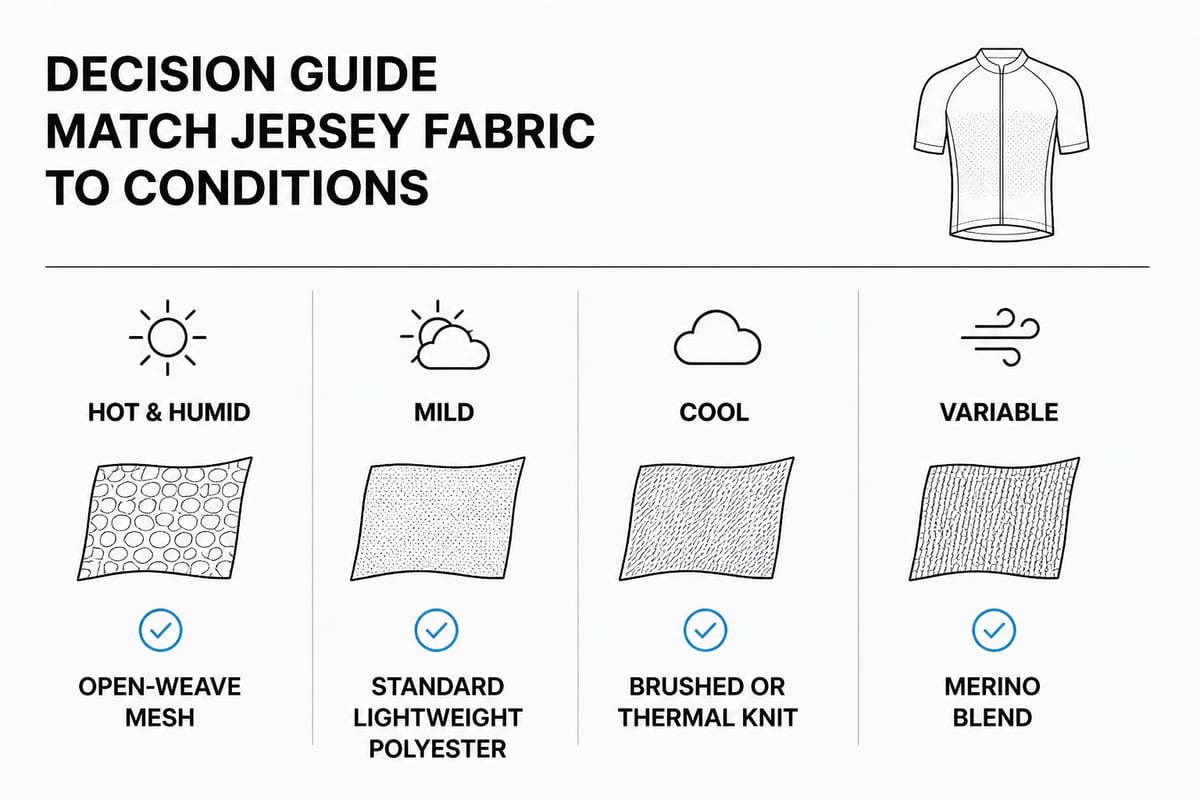
Choose fabric by the temperature and humidity you ride in most, because the material determines how quickly sweat leaves your skin and how much heat escapes.
Most performance jerseys use polyester or polyester blends, often with elastane for stretch. Differences appear in the knit: an open mesh breathes better in heat, a denser knit resists wind, and a brushed interior adds warmth. Merino blends manage odor and temperature well across a wide range, though they are usually heavier than pure synthetics.
CCN Sport explains the trade-offs in more depth in its breakdown of the best fabrics for cycling jerseys. When specifying fabric for a team, ask for performance data or samples and consider the hottest and coldest races on your calendar, not just the average ride.
What Should You Wear at Different Temperatures?
Temperature is the simplest way to choose between short sleeves, long sleeves and layers, and published guidance gives clear starting ranges.
According to POC, a standard short- or long-sleeve jersey with bib shorts is typically sufficient between 15 and 22°C (59 to 72°F), and above 22°C (72°F) a lightweight, breathable jersey with mesh panels can help airflow. For colder rides, POC describes a three-layer system: a moisture-wicking base layer, an insulating mid-layer, and a wind- and rain-protective outer layer, removing layers as conditions warm.
A few practical rules follow from this:
- Start slightly cool. You warm up within the first 15 minutes.
- Use a base layer under a jersey in cold weather rather than relying on one thick top.
- Carry a packable wind layer in a rear pocket for descents.
- Choose a jersey with a zipper you can open and close with one hand.
For more detail across the full range, Canyon publishes a temperature-by-temperature guide to cycling clothing, and Cycling UK explains how winter cycling layers fit together, including where short- and long-sleeve jerseys belong in a cold-weather system.
Short Sleeve or Long Sleeve?
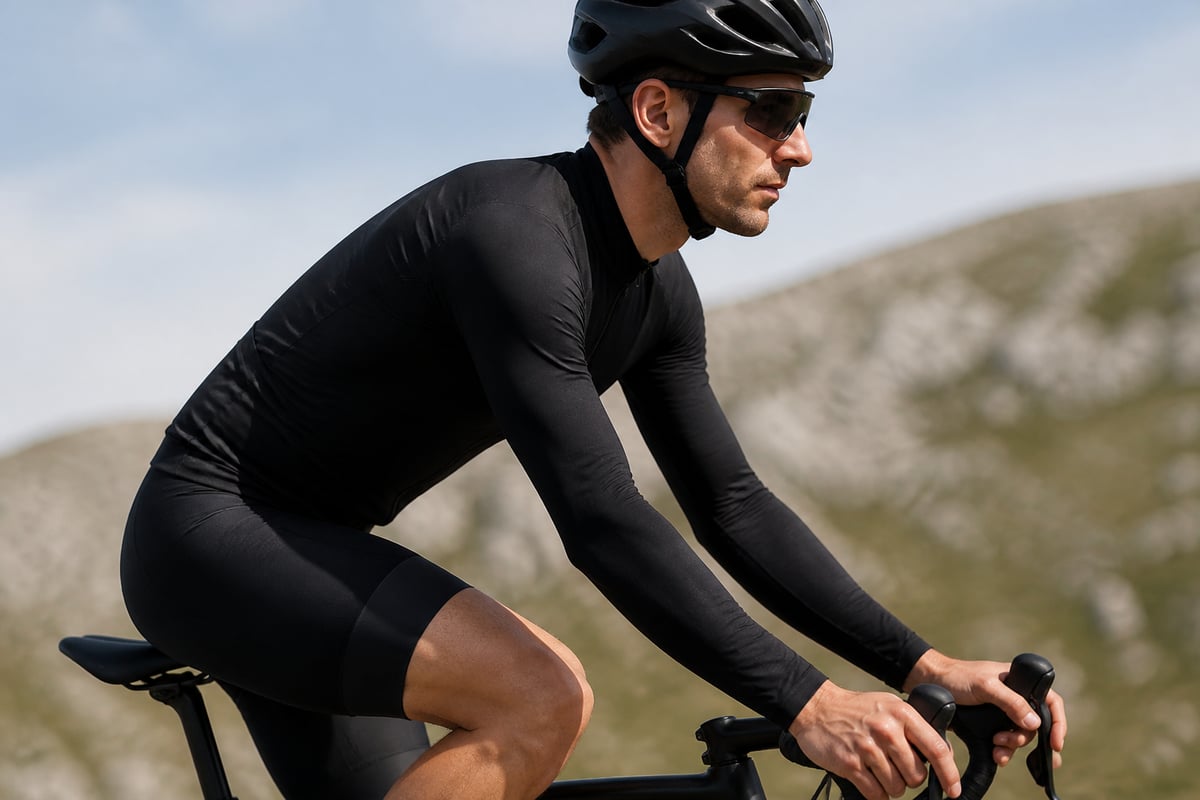
Short sleeves suit most riding above roughly 15°C, while long sleeves cover cool mornings, shoulder seasons and sun-exposed riders.
Short-sleeve jerseys offer the broadest use and pair with arm warmers when the day starts cold and turns warm. Long-sleeve jerseys remove the need for arm warmers, give consistent coverage and protect skin from sun, which matters on long summer days as much as on cold ones. A lightweight long-sleeve with a UV-rated fabric can be cooler than bare skin in strong sun. Competitive Cyclist explains how UPF ratings work and how fabric, construction, wetness and stretch affect a garment's UV protection.
For clubs, a sensible kit list often includes both: a short-sleeve race jersey for the main season and a long-sleeve option for spring and autumn. CCN Sport's All Day men's long-sleeve jersey illustrates the kind of cut used for cooler-weather riding.
How Should a Cycling Jersey Fit?
A properly fitted jersey is snug across the chest, shoulders and arms when you are in the riding position, without restricting breathing or pulling at the zipper.
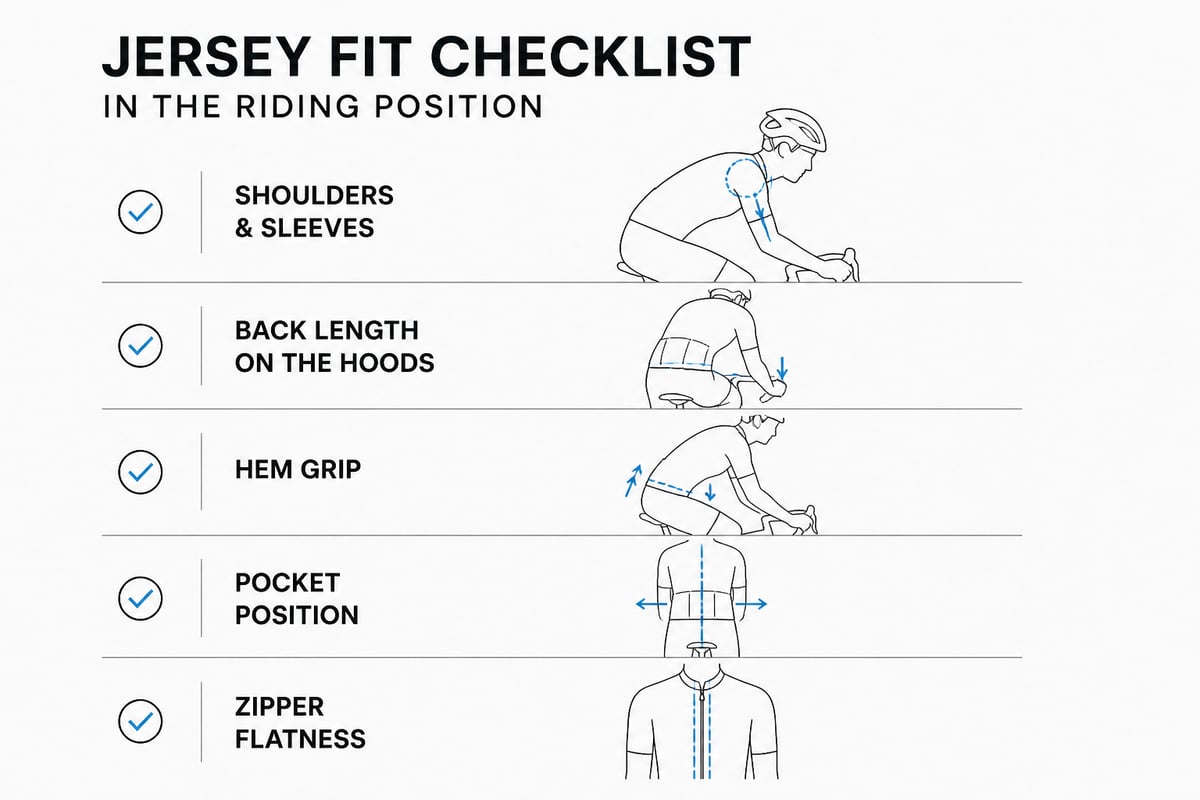
Test fit on the bike, not standing up. Check these points:
- Shoulders and sleeves: No bunching at the armpit and no tight band cutting into the bicep.
- Back length: The hem should cover your lower back when you are on the hoods.
- Hem grip: It should hold position without squeezing.
- Pockets: They should sit flat and carry weight without sagging.
- Zipper: It should lie flat when closed.
Race fit and club fit differ. Race cuts are more aggressive and favor lean riders in a tucked position, while club cuts allow a little more room through the torso. Teams with a wide mix of body types often find it simplest to offer a pattern with some tolerance in the cut and clear sizing guidance for every member.
What Features Are Worth Paying For?
Features matter when they solve a real problem on the road, so prioritize the details that affect comfort, safety and durability.
- Reflective trim: Useful for early or late rides and for team training in low light.
- Mesh side or back panels: Add ventilation where heat builds up.
- Zippered pocket: Secures a key or card.
- Flat-lock seams: Reduce chafing over long distances.
- Sun-protective fabric: Valuable for riders spending hours exposed.
- Printed graphics: Sublimation prints that run through the fabric resist cracking and fading better than surface applications.
What Should Teams and Clubs Know About Custom Race Kits?
Custom kits let a team control fit, fabric and branding in one order, and the key is to plan the design and the sizing process before production starts.
Retail jerseys work for individuals, but a team needs matching colors, consistent logo placement and sponsor visibility across every rider. Custom production solves all three. CCN Sport builds custom kits in its own factories in Shenzhen, China and Dasmarinas, Philippines, with an advanced sublimation process, and its design team works to an aerodynamic, comfort and style brief. Minimum orders start at 5 main pieces, which makes custom work realistic for small clubs and development squads as well as larger programs. More than a dozen pro teams, national programs and elite clubs rely on CCN gear each season.
The Factor Racing team kit shows how a professional program approaches the jersey. The Factor Racing Team Kit pairs a race-tuned fit with lightweight, breathable fabric and a distinctive team look.
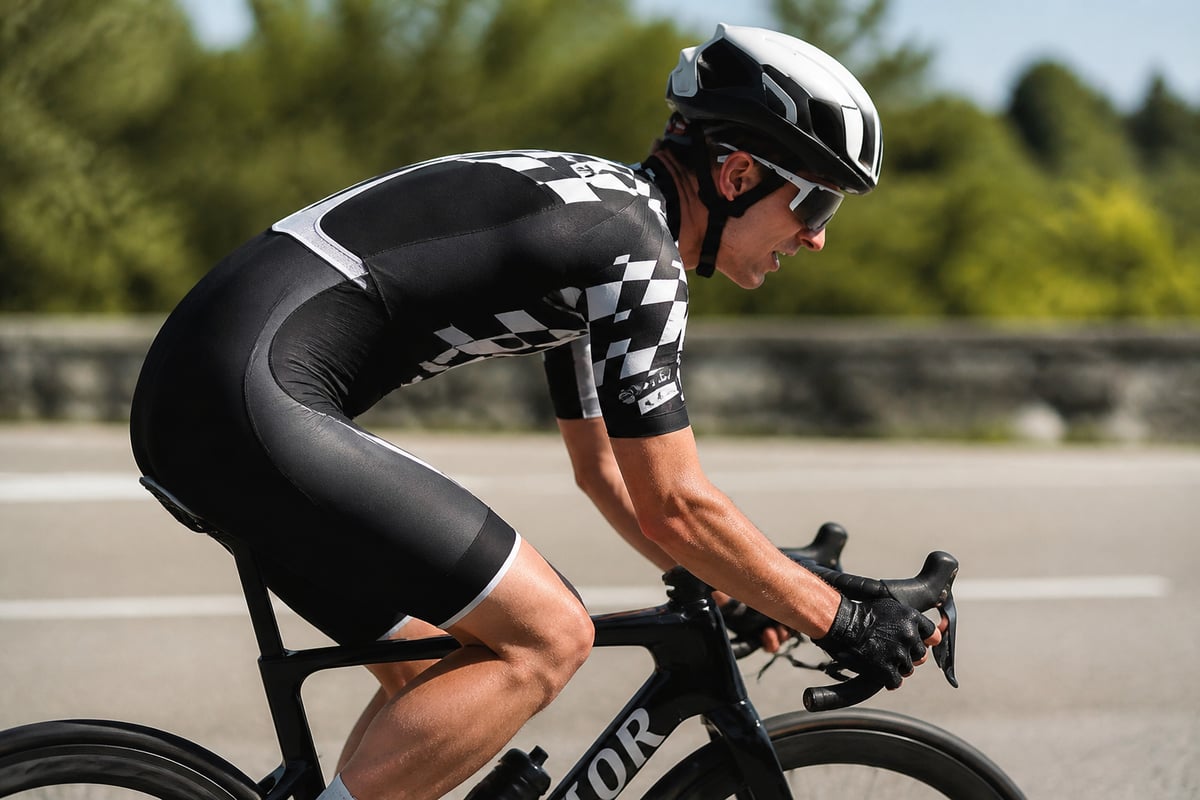
For more examples of how teams approach design, see how CCN Sport worked on the Factor Racing 2026 jersey.
How should you plan a team order?
Work through these steps in order to avoid rework:
- Confirm the design brief, sponsor logos and color palette with your committee.
- Choose cuts for each discipline and fabric weights for each season.
- Collect accurate measurements from every rider before ordering.
- Review the digital proof carefully, checking logos, spelling and placement.
- Order extras for new members and for replacement needs.
Confirm sizing and proofs before approving production, since custom work is made to order. For lead times, sizing tools and order specifics, check CCN Sport's product pages or contact the team directly rather than assuming standard terms.
How do you handle crashes and sizing changes?
Teams lose kit to crashes and see riders change size across a season. CCN Sport offers a crash reorder at 30% less than retail price and a size reorder program for 30% less, which helps a squad keep a consistent look without paying full price to replace damaged or ill-fitting pieces. Factory-direct pricing and a limited lifetime warranty add to the value over several seasons.
How Do You Care for a Cycling Jersey So It Lasts?
Wash jerseys inside out in cool water with a gentle detergent and air-dry them, because heat and softener shorten the life of technical fabric.
BBB Cycling advises using detergent without fabric softener, closing zippers, and washing garments inside out to help protect the fabric. Softener coats fibers and reduces moisture wicking, so avoid it entirely. Skip the dryer and any high-heat setting, hang jerseys to dry, and wash soon after hard rides to prevent odor from setting in.
Good care matters more for a team kit with sublimated graphics, since protecting the fabric also protects the print. Pass these instructions along to every rider when kit is delivered.
What Mistakes Should You Avoid When Buying?
Most poor purchases come from a handful of avoidable errors, and each one is easy to prevent.
- Buying on looks alone: A striking design on a poorly cut jersey will be uncomfortable by the second hour.
- Ignoring climate: A heavy fabric suits a cold-weather team badly in a hot-climate race.
- Skipping the proof review: Typos and logo errors are costly once printed.
- Guessing sizes: Measure every rider instead of estimating.
- Ordering one weight only: A single fabric rarely covers a full season.
Choosing a jersey for biking is a series of small decisions about fabric, fit, features and care. Make them in the right order and the result is a kit that performs, lasts and looks consistent from the first ride to the last.
Your next step is to gather rider measurements and a short list of sponsor logos, then decide which cuts and fabric weights your squad needs for the season ahead. CCN Sport can turn that brief into matching race kits, from the Factor Racing Team Kit approach used by professional programs to club-level orders starting at 5 main pieces, all produced in its own factories with precision sublimation and a limited lifetime warranty. When your design brief is ready, start your custom kit with the CCN Sport team and take it from concept to a finished jersey your riders will be proud to wear.

Share:
How to Measure Cycling Inseam for Better Fit
Bicycle Riding Jerseys: Top Picks for Every Rider