

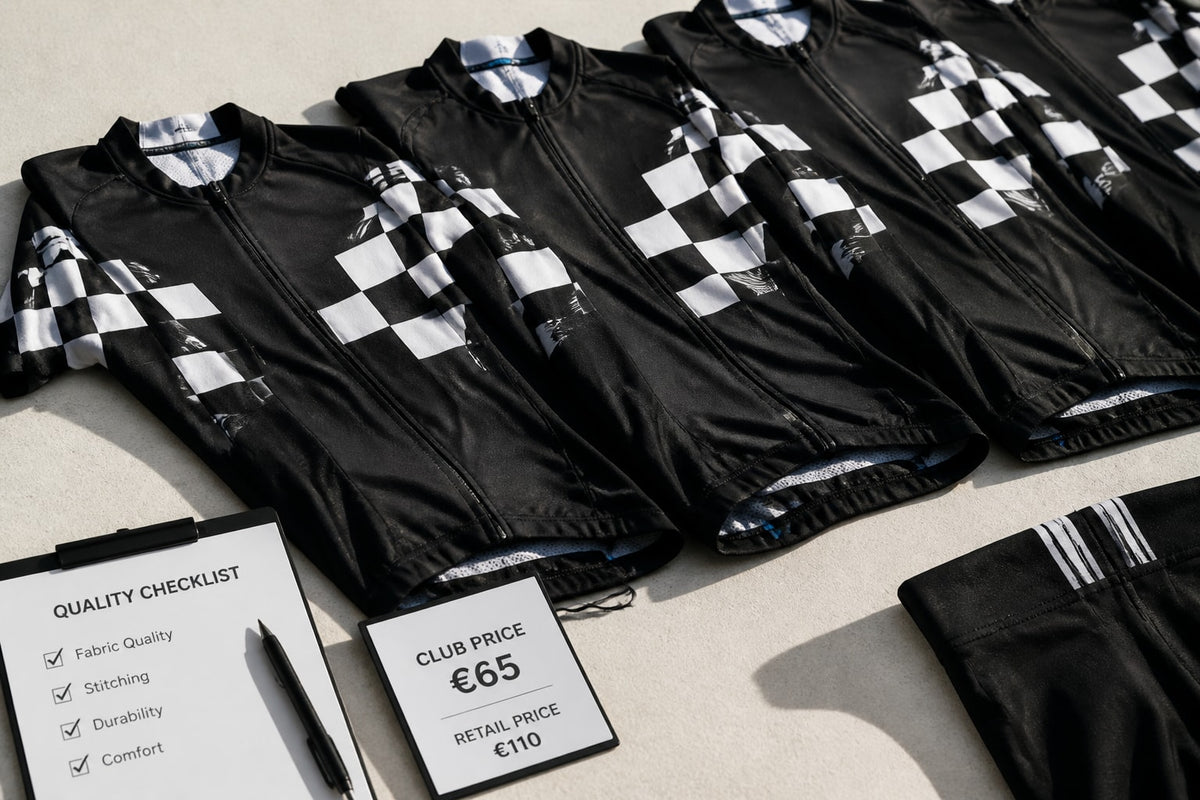
A bike clothing discount is worth taking when it lowers the price per rider without changing the fabric, chamois, stitching or print quality you specified. For a club or team, the most reliable savings come from volume pricing, factory-direct production and reorder programs rather than from end-of-season clearance racks.
Clearance sales work for individual riders who need one pair of bibs in a leftover size. They work poorly for a club that needs forty matching jerseys in the same colorway, because sale stock is limited, sizes run out and designs rarely match from one drop to the next. This guide explains how to evaluate discounts, which savings are real, and how to protect quality while keeping the budget under control.
What Counts as a Real Bike Clothing Discount?
A real discount lowers the cost of equal quality; a fake one lowers the price by quietly lowering the specification. The difference is easy to miss on a product page, so it helps to know the four common forms savings take:
- Seasonal clearance: Last season's designs sold at reduced prices, usually in broken size runs.
- Promotional codes: Percentage-off offers that often exclude new arrivals or custom work.
- Volume pricing: A lower unit price as the order quantity rises, common in team and club programs.
- Factory-direct pricing: Savings from removing wholesalers, distributors and retail markups between the producer and the buyer.
For matching race kits, the last two matter most. Clearance and promo codes are built for single-item shoppers and rarely cover a full roster.
Before accepting any offer, compare it against the original specification, not just the original price. A jersey marked down 40 percent from an inflated list price may still cost more than a fairly priced one at full value. Our own breakdown of cycling sale clothing covers how to read a markdown honestly.
Why Clearance Racks Rarely Work for Teams
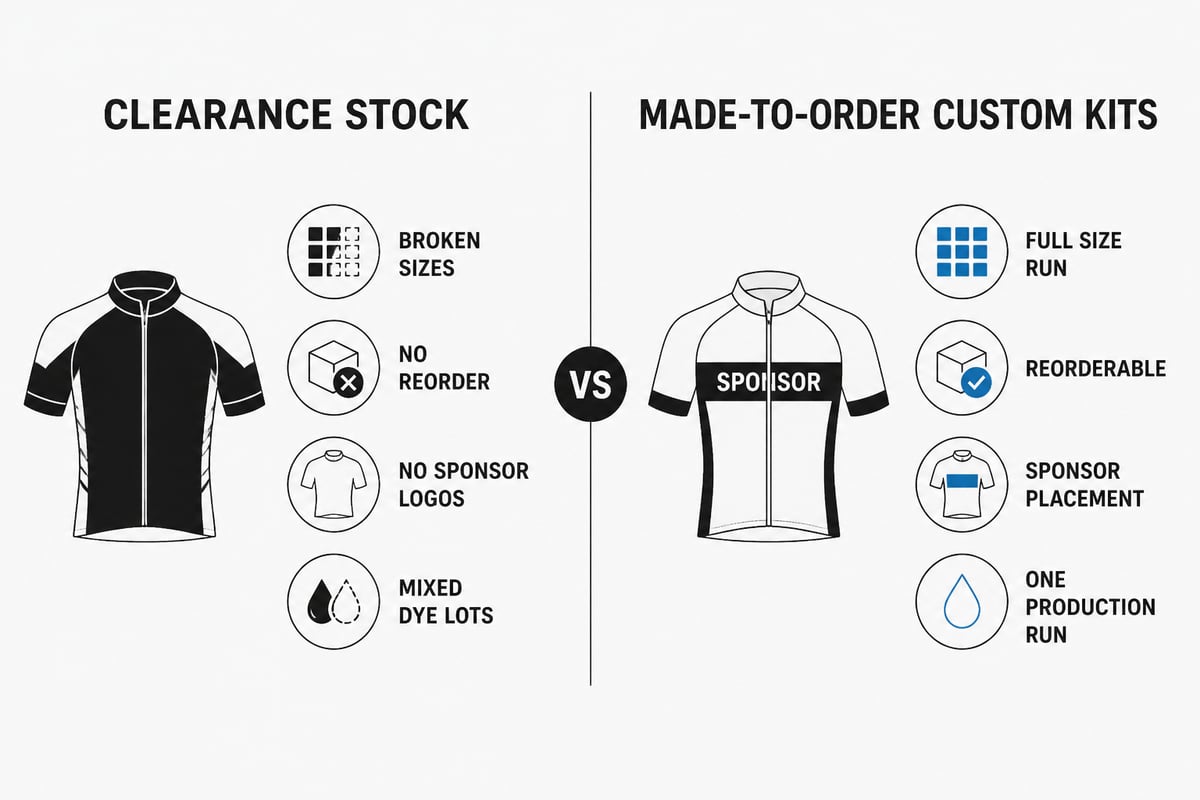
Clearance stock fails teams because it cannot guarantee matching colors, complete size runs or consistent fabric across riders. A club needs identical kits on the start line, and a discount that delivers eight jerseys in one dye lot and twelve in another creates a visual problem on race day.
Consider the practical limits:
- Size availability: Sale racks hold leftovers, usually the extremes of the size range.
- Design continuity: Discontinued designs cannot be reordered when a new rider joins mid-season.
- Sponsor logos: Stock kits carry the manufacturer's branding, not your sponsors' marks.
- Fabric variation: Different production runs can differ slightly in shade and hand feel.
The result is a kit that saves money in week one and costs more in replacements by week twelve. A made-to-order program removes these risks because every piece comes from the same production run to your design.
How to Judge Quality Before You Chase a Bike Clothing Discount
Quality can be checked in five places before you commit to any price: fabric, chamois, seams, zippers and print. A low price is only a saving if all five hold up.
Fabric and Fit
Look for a lightweight, breathable knit with a stated stretch recovery and a cut designed for the riding position. Race fits should sit close without restricting the shoulders or compressing the stomach on the bike. Our article on what makes cycling clothing breathable and lightweight explains the fabric terms you will see on spec sheets.
Chamois and Bib Construction
The pad is the component riders notice first and forgive last. Check the pad density, the shape for the discipline, and whether the bib straps lie flat. Poorly graded pads are the most common hidden cost-cutting measure.
Seams, Zips and Gripper Hems
Flatlock stitching, full-length reliable zippers and silicone gripper hems that do not roll are inexpensive to specify and expensive to repair. Inspect them first when comparing samples.
Print Durability
Sublimation prints dye the fabric itself, so colors do not crack or peel the way applied graphics can. Ask whether the print is sublimated and whether it holds through repeated washing.
Where Real Savings Come From for Clubs and Teams
The largest legitimate savings for a team come from ordering made-to-order kits at factory-direct prices and planning reorders in advance. This approach shifts the discount from the product to the process, so quality stays fixed while cost falls.
Three levers deliver most of the value:
- Low minimums with volume tiers: Custom orders can be placed for small squads, so a team is not forced to overbuy to qualify for pricing.
- Factory-direct pricing: CCN Sport produces in its own facilities in China and the Philippines, which removes intermediary markups on custom apparel.
- Reorder programs: Reorder programs are available for replacing damaged or mis-sized pieces, which lowers the cost of replacing them compared with buying new at full price.
Teams that plan the season around one main order plus a smaller top-up reorder typically spend less per rider than teams that buy twice at full price.
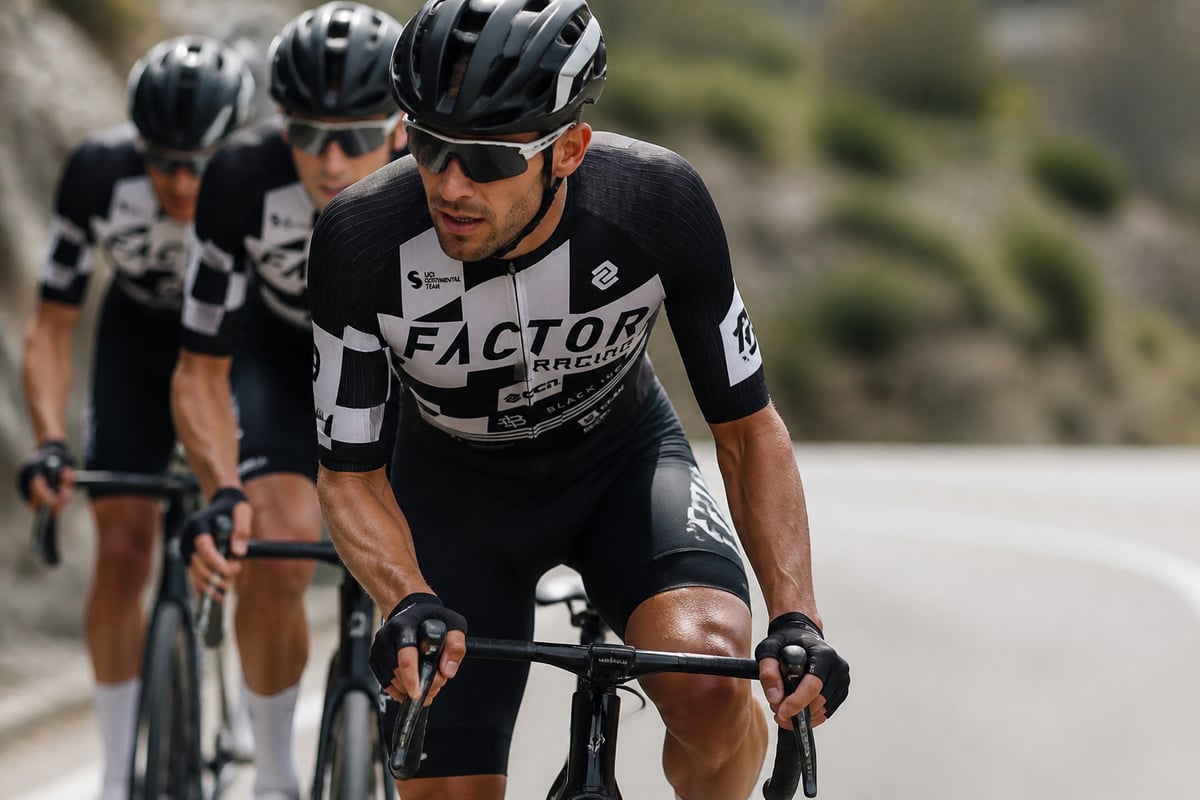
A good example of what a unified team kit looks like is the Factor Racing Team Kit, which pairs a race-tuned fit with lightweight, breathable fabric and a single recognizable identity across the whole squad.
Timing Your Order to Lower the Cost
Ordering early in the planning cycle can lower cost because it avoids rush production and gives you time to compare samples and correct errors. Many expensive mistakes in a team order come from compressed timelines, not from the base price.
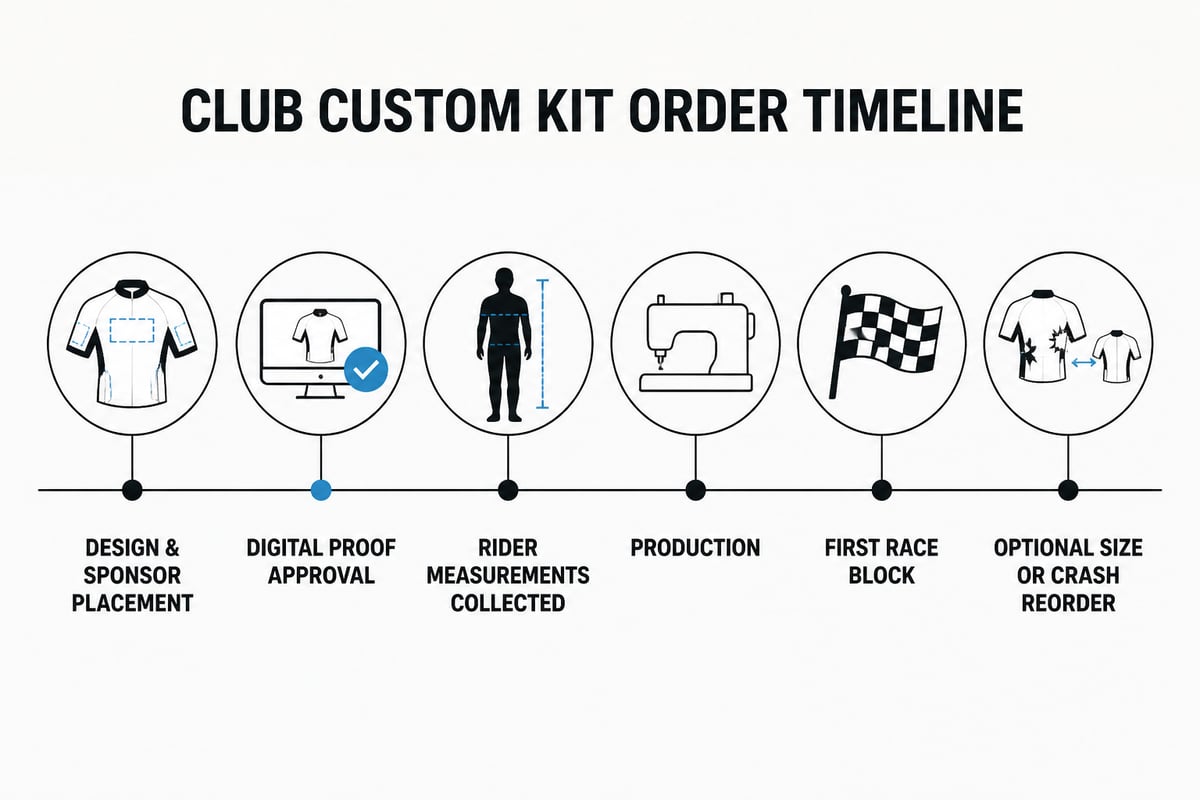
A workable schedule looks like this:
- Eight to twelve weeks before the first race: Finalize the design and sponsor placements.
- Six to eight weeks before: Approve the digital proof and confirm the size list.
- Before the order is placed: Collect measurements from every rider, including late joiners.
- After the first race block: Place a small size or crash reorder if needed.
Exact production and delivery timelines vary by order, so confirm them with the production team on the CCN Sport contact page before you commit to a race date. Custom items are made to order and are non-refundable, which makes accurate sizing and design approval the most important cost control you have.
Design Choices That Cut Cost Without Cutting Performance
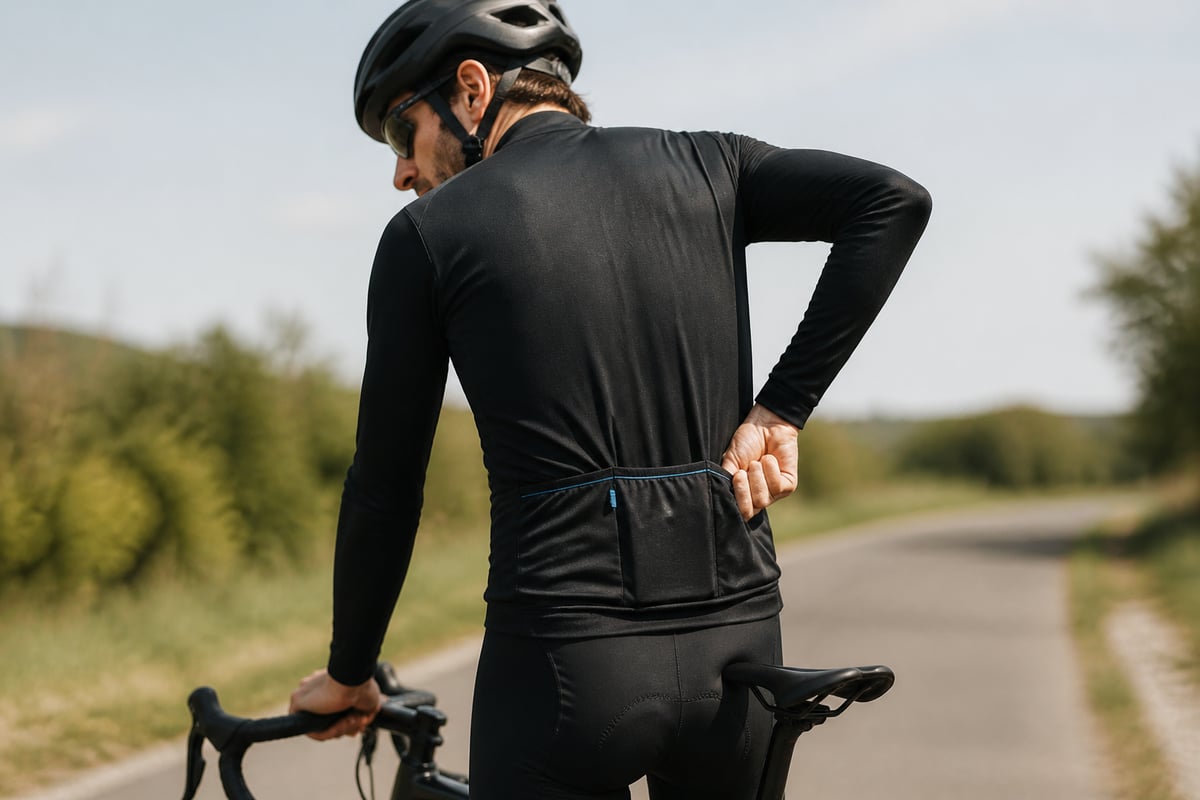
Simple design decisions can reduce cost while preserving the fabric and fit that matter on the road. Sublimation prints the design into the fabric, so the choice of garment spec matters more to price than the number of colors.
- Standardize the cut: One jersey and one bib pattern across the roster simplifies production and reordering.
- Limit special options: Reserve premium add-ons such as extra-long sleeves or gilets for the riders who need them.
- Choose seasonal weights deliberately: A short-sleeve summer kit and a single thermal layer cover most of the year; our guide to winter bike clothes helps you decide what to add.
- Plan accessories together: Arm warmers, caps and socks ordered with the main kit usually cost less than ordered separately later. Our overview of bike arm warmers shows what is worth adding.
Safety belongs in the design brief as well. The UK Highway Code, Rule 59 advises that light-coloured or fluorescent clothing can improve visibility in daylight and poor light, and that reflective clothing or accessories can help in the dark. A high-visibility accent on a team kit costs little and serves every rider on training rides.
Making Discounted Kit Last Longer
The cheapest kit is the one you do not have to replace, and care habits decide how long a garment stays race-ready. Passing simple care guidance to your riders protects the investment you made in fabric and print.
According to BikeRadar, cycling kit should be washed at 30°C when the care label permits, and fabric conditioner can damage seam-tape adhesion and durable water-repellent coatings. The same source reports that Gore recommends closing zips on Gore-Tex garments before washing, using liquid rather than powder detergent, and avoiding fabric softener and bleach.
BBB Cycling adds practical points for riders:
- Wash shorts promptly after each ride to help prevent bacteria from settling in the padding.
- Use a washing net and a delicate machine cycle when hand-washing is impractical.
- Air-dry rather than tumble-drying, and skip fabric softener.
A one-page care card included with each rider's kit takes minutes to write and can extend the life of a season's order. Good care also keeps any warranty conversation simple.
Keeping Your Club Informed About Offers and Deadlines
Order deadlines, size collection and reorder windows only save money if every rider hears about them on time. Clubs that rely on scattered group chats often miss cutoff dates and end up paying for rushed or duplicate orders.
A simple email list solves this. A tool such as Astonish Email, built for small-business email marketing, lets a club send one message with the order deadline, the size chart and the reorder window to every member at once. Pair that with a shared spreadsheet of sizes and you remove the most common sources of reorder cost: wrong sizes, late joiners and forgotten riders.
A sensible cadence keeps the list useful without becoming noise. Send one announcement when the design is approved, one reminder a week before the measurement deadline, and one final notice on the day the order closes. Each message should carry the same three items: the date, the action required of the rider and the person to contact with questions. Because custom pieces are non-refundable, include a line asking riders to confirm their size against the chart rather than guessing from a previous brand. After delivery, use the same list to announce any size or crash reorder window, so a rider who damaged a jersey in a fall hears about the 30% reorder pricing before the window passes.
A Practical Checklist Before You Buy
Run any bike clothing discount through this short test before paying. If an offer fails more than one item, the saving is probably coming from the specification.
- Is the fabric weight and type stated, and does it match your riding conditions?
- Is the chamois described by density and intended discipline?
- Are the seams, zippers and hems specified, not implied?
- Is the print sublimated, and can the same design be reordered later?
- Can you reorder identical pieces mid-season at a planned discount?
- Are sizes confirmed against a size chart, with the policy on non-refundable custom orders understood in advance?
Apply the list to real quotes by putting two offers side by side and writing the answer to each question next to each price. A quote that says only "breathable jersey" fails the first item, while one that names the fabric and its intended temperature range passes. Do the same for visibility: if your riders train in poor light, confirm the design includes light-coloured or fluorescent panels or reflective details, in line with the UK Highway Code's Rule 59. Finally, check what the garment asks of the rider afterward. Kit that must be washed at 30°C, air-dried and kept away from fabric softener is normal, but the care instructions should be provided, not left for riders to guess.
Start by listing your roster, the sizes each rider needs and the date of your first race, because those three facts determine every price and deadline in a team order. CCN Sport has produced custom cycling apparel since 2005, and more than a dozen pro teams, national programs and elite clubs rely on its gear every season, including the Factor Racing Team Kit as an example of a unified team look. When your list is ready, start your custom kit with CCN Sport, where traditional craftsmanship and modern sublimation come together to build premium cycling apparel designed to perform and last.

Share:
How to Prepare Race Day Kit for Fast, Calm Starts
Bike Jersey Design: A Guide to Creating Your Own Kit