


A bicycle outfit is a set of clothing designed specifically for riding: typically a jersey, bib shorts or tights, socks, gloves, a cap and weather layers, built from technical fabrics and cut for a riding position. The term is used interchangeably with cycling kit, and a "kit" usually implies that the pieces are matched in color and design, as in a club or team uniform.
This article explains what each piece does, how the fabrics and fit work, what changes by season and discipline, and what teams and clubs should know before ordering a matched custom kit.
What Does a Bicycle Outfit Include?
A complete bicycle outfit includes six core items: a jersey, bib shorts, socks, gloves, a cap or helmet liner, and weather-specific layers. Each solves a problem that ordinary clothing does not.
- Jersey: A fitted top with a longer rear hem and rear pockets, cut so it does not ride up or flap when you are bent forward on the bars.
- Bib shorts: Shorts held up by shoulder straps instead of a waistband, with a padded insert (the chamois) that reduces pressure and friction.
- Socks: Thin, moisture-managing socks, often with a taller aero cuff for racing.
- Gloves: Padded palms to absorb road vibration and protect hands in a fall.
- Cap or headband: Sun and sweat control under the helmet.
- Layers: Base layers, arm and leg warmers, vests, and shell jackets that adapt the kit to temperature and rain.
Footwear, helmet and eyewear sit alongside these items, but clothing is what most people mean by the phrase. For a closer look at the full list of equipment around the clothing, the bicycle gear overview covers the wider setup.
How Does a Bicycle Outfit Work?
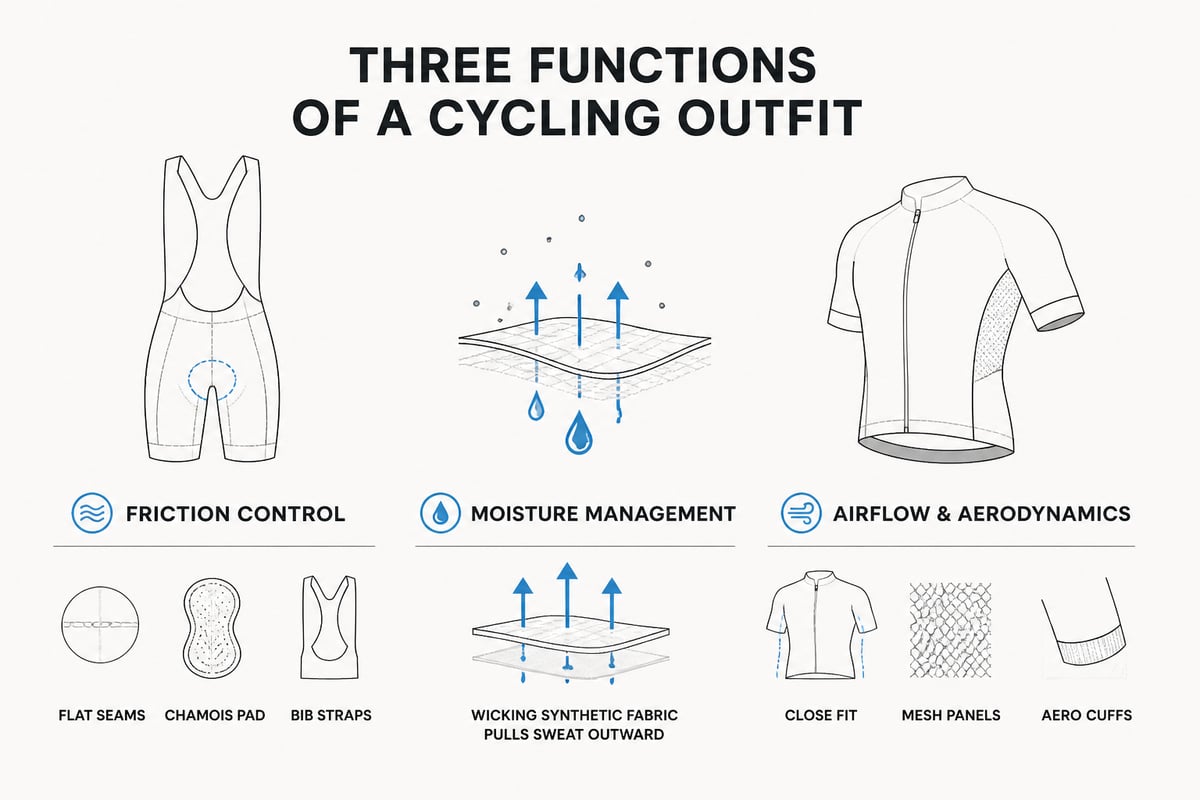
A bicycle outfit works by managing three things during a ride: friction, moisture and airflow. Every piece is shaped around one of those jobs.
Fit comes first. Cycling clothing is cut close to the body so fabric does not catch the wind, bunch behind the knee or rub on the saddle. A jersey is longer in the back to cover your lower spine when you lean forward, and sleeves are cut to the arm position on the bars rather than standing posture. The close cut also serves a safety purpose: the UK Highway Code advises cyclists to avoid clothing that could catch in the chain or wheels or obscure lights, and a fitted garment is far less likely to do either.
Fabric does the second job. Synthetic knits move sweat from the skin to the outer surface, where it evaporates. Cotton holds moisture, becomes heavy and chafes, which is why it is avoided for long rides. The effect is easy to notice on a climb followed by a descent: a wicking jersey dries within minutes of the effort easing, while a wet cotton shirt stays cold and clinging against the chest.
The third job is compression and structure. Bib shorts use stretch panels and flat seams to hold muscle steady and prevent seam irritation across hours in the saddle. The shoulder straps replace a waistband, so nothing digs into the abdomen when you are folded forward on the bars. The chamois pad is shaped for the contact points of a seated rider, not for walking.
Examples of a Bicycle Outfit in Use
A bicycle outfit changes with the kind of ride, and the same rider will own several versions of it. Four common setups show how the pieces combine.
Summer road race or club ride
A lightweight short-sleeve jersey, bib shorts, aero socks and a cap. Fabric is thin and breathable, colors are often bright, and the priority is cooling. A set such as the Factor UCI team men's short sleeve jersey paired with matching bib shorts illustrates how a team-styled jersey and short work as one matched unit.
Cool-weather training
Add arm warmers, a thermal vest and sometimes a base layer under the jersey. The advantage of this layered approach is adjustability: warmers and vests can be removed and stowed in a rear pocket as the day warms. Pieces such as thermal arm warmers and a thermo wind vest are typical here.
Wet or cold conditions
A long-sleeve jersey, thermal tights or knee warmers, and a waterproof shell. NSW Government guidance recommends cycling pants and a bright jersey for long journeys, clothing that allows airflow, and a weatherproof jacket and waterproof pants for rain.
Triathlon and time trials
Skin-tight, low-drag clothing, often a one-piece suit, with a minimal pad suited to a shorter transition. The goal is reducing wind resistance, so loose fabric is the main thing to avoid.
For women's fits and cuts, the guide to a women's biking outfit goes into pad shapes and bib designs in detail.
Why Fabric and Fit Decide Performance
Fabric and fit decide performance because they control heat, drag and comfort over hours of repetitive motion. Small differences accumulate on a long ride.
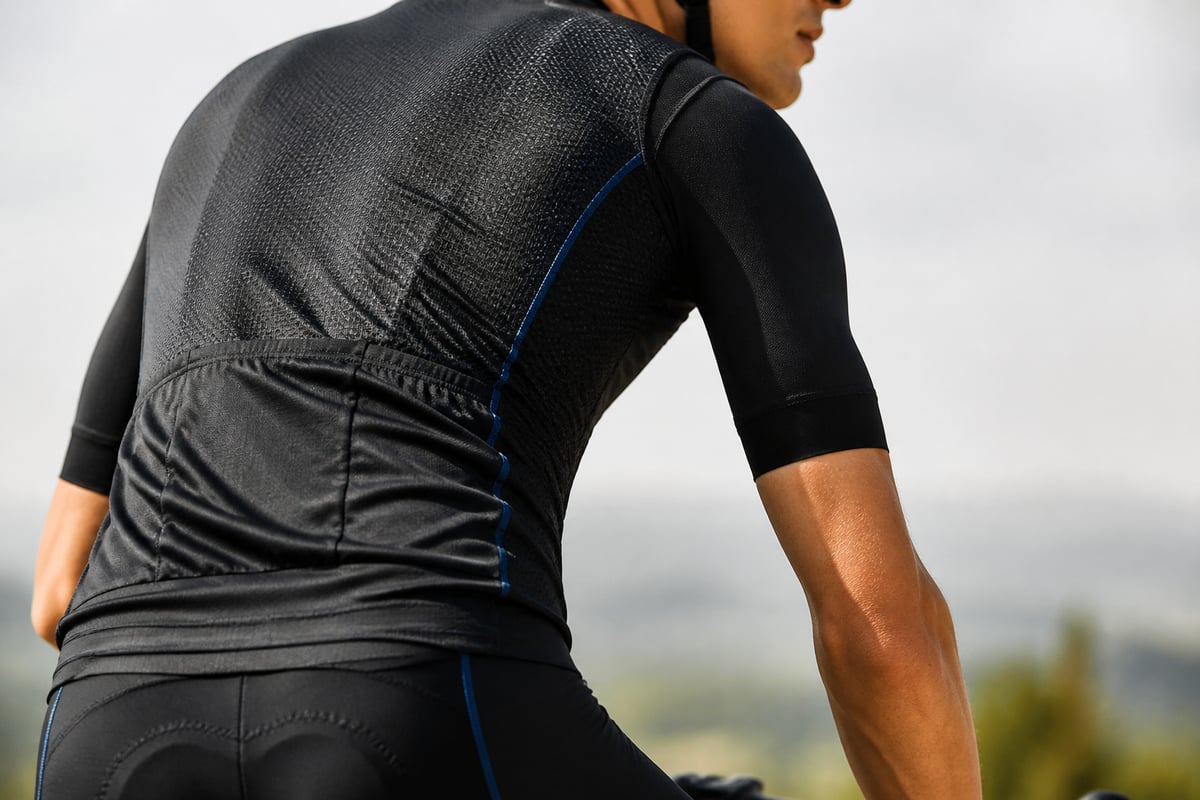
A close fit removes the flapping fabric that creates drag at speed. Stretch panels allow full pedaling range without the garment pulling. Mesh zones at the back and sides increase ventilation, while denser knits on the shoulders and thighs add sun protection and durability.
Here is a quick comparison of how common materials behave in a bicycle outfit:
| Material | Moisture handling | Typical use | Limitation |
|---|---|---|---|
| Polyester knit | Wicks and dries quickly | Jerseys, bibs, socks | Can retain odor if not washed promptly |
| Elastane blend | Adds stretch and recovery | Bibs, skinsuits | Loses elasticity with heat and age |
| Merino wool | Insulates when damp | Base layers, socks | Slower to dry, less durable |
| Cotton | Absorbs and holds sweat | Casual wear only | Heavy, chafes on long rides |
Sublimation printing is relevant here as well. In sublimation, dye is transferred into polyester fibers by heat rather than sitting on top as a coating, so graphics do not crack, peel or add stiffness to the fabric. That is why most custom team kit uses this method.
Safety and Visibility: What Guidelines Recommend
Cycling clothing is also safety equipment, because color and fit affect how well drivers see you and whether fabric can snag a drivetrain. Public guidance is consistent on both points.
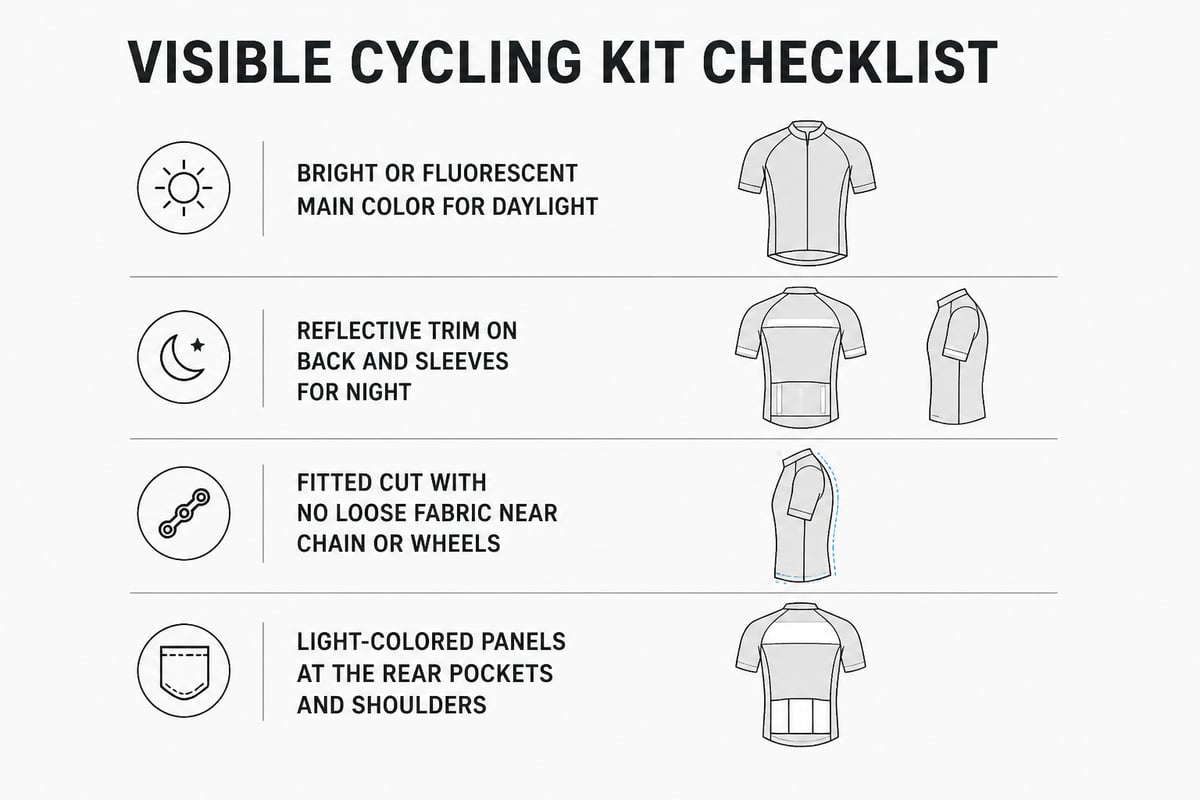
The UK Highway Code advises avoiding clothing that could catch in the chain or wheels or obscure lights, and notes that light-colored or fluorescent clothing helps in daylight and poor light, while reflective clothing or accessories improve visibility in the dark. Hong Kong's Transport Department, through its 1823 service, gives similar advice: bright or light-colored clothing by day, reflective or fluorescent clothing at night or in poor visibility, and avoiding loose clothing or laces that could catch in the wheels or chain.
NSW guidance goes a step further for low light. It recommends a reflective vest at night, and white or fluorescent green clothing if no vest is available, so that car lights reflect off the rider.
For a team designer, this has a practical consequence. A dark, understated colorway may look sharp in a photograph, but a kit with high-contrast panels, light sleeves or reflective trim is easier for traffic to read. Visibility can be built into the design rather than added later.
Matched Team Kit: What Changes for Clubs and Programs
A matched bicycle outfit for a team or club is a coordinated uniform where every rider wears the same design in an individually fitted size. This adds planning that an individual buyer never faces.
Teams generally need to settle these points before production:
- Design brief: Colors, sponsor placement, name and number fields, and how graphics wrap across jersey, bibs and socks.
- Piece list: Race jersey, training jersey, bibs, skinsuit, vest, warmers, cap, socks, bike cover.
- Sizing plan: A sizing run or fit session across the roster, since mixed body types are common.
- Reorder logic: What happens when a rider crashes, changes size or joins mid-season.
- Quantity: Whether the supplier can accommodate a small roster or only large runs.
That last point often decides whether a small club can get a properly matched kit at all. Many custom suppliers set minimums that suit only large orders.
CCN Sport builds custom cycling apparel in its own factories in Shenzhen, China and Dasmarinas, Philippines, with a design team that works to an aerodynamic, comfort and style brief. Minimum orders start at 5 main pieces, which suits smaller clubs, and the company has made custom kit since 2005. For teams that outgrow a first order, a crash reorder at 30% less than retail price and a size reorder program for 30% less address the reorder problem directly.
Pricing, lead times and sizing rules are best confirmed on the product pages or through the contact page, since those details depend on the order.
How to Build a Bicycle Outfit That Works
The most reliable way to build a bicycle outfit is to start with the pieces closest to the body and add layers outward. This prevents the common mistake of buying a striking jersey and neglecting the shorts, where comfort is actually decided.
- Choose the bib shorts first. Pad shape, strap design and fit determine whether you can ride for three hours or six. A women's bib short and a men's cut differ in pad geometry for this reason.
- Match the jersey to the conditions. Lightweight and ventilated for summer, with a men's jersey range offering short-sleeve, long-sleeve and aero-cut options.
- Add a base layer if temperatures drop. A close-fitting base layer adds warmth without bulk.
- Carry adjustable layers. Warmers and a vest pack small and cover a wide temperature range.
- Finish with small items. Socks, gloves and a cycling cap complete the matched look and handle sun and sweat.
Fit deserves a second look at each step. Cycling clothing should feel snug standing up, because it is cut for the riding position. A jersey that feels tight at the chest while you stand often fits correctly once you are in the drops.
Related Terms
Several terms overlap with bicycle outfit, and knowing them helps when comparing products or briefing a manufacturer. Retailers and suppliers often use them loosely, so a product listed as "cycling apparel" may be a single jersey, while "kit" almost always means a coordinated set.
- Cycling kit: The standard term for a matched jersey and shorts, especially in racing.
- Cycling apparel: The broad category covering all riding clothing, from base layers to rain shells.
- Bib shorts: Shorts with shoulder straps and a chamois, the foundation of most kits.
- Skinsuit: A one-piece jersey and short for time trials and short road races, chosen when reducing wind resistance matters more than convenience.
- Sublimation: The printing process that embeds dye in polyester for durable graphics.
- Chamois: The padded insert in cycling shorts, available in different thicknesses and shapes for different ride lengths and body types.
- Base layer: A thin moisture-wicking garment worn directly on the skin, under the jersey.
- Team kit: A matched uniform produced for a club, team or national program, usually with sponsor placement and name or number fields.
Your next step is to list the pieces your roster actually needs, such as race jerseys, bibs, vests and socks, along with sizes and a rough quantity. With that list in hand, CCN Sport can turn it into a finished uniform, from the design brief through production of custom cycling apparel made in its own factories in China and the Philippines, where sublimation printing keeps colors vibrant and graphics durable. If you are ready to build a matched set for your club or program, start your custom kit with a quote request.

Share:
Cycling Kit Warranties Riders Should Understand